


Specialized Miele Appliance Repair in San Francisco
Mon–Sat: 8:00 AM – 7:00 PM
Lights come on but the fan stays silent, or the blower runs weakly and the kitchen fills with steam. Learn what to check safely and what points to a motor or control fault.
Miele repairSan Francisco Bay Area
A hood is easy to ignore until the day you sear a steak and the smoke has nowhere to go. When the fan on a Miele range hood stops, slows or turns noisy, the cause can sit in four places: the power reaching it, the controls that ask for the fan, the motor and blower itself, or the duct that carries the air away. Working through them in order is quicker than assuming the motor has failed.
Total silence points to power. Check whether the lights and the fan share a switch or touch panel that is locked, whether the breaker has tripped, and whether the hood plugs into an outlet behind a cabinet where someone may have switched something off. Hoods that connect through a wall outlet inside the chimney cover are common in flats, and a loose plug is a surprisingly frequent cause.
The control is alive, so the question is whether the request reaches the motor. A fan that does not start at any speed can mean a failed motor, a failed capacitor or relay, or a control board that is not sending the signal. A technician measures those with the cover off. You should not.
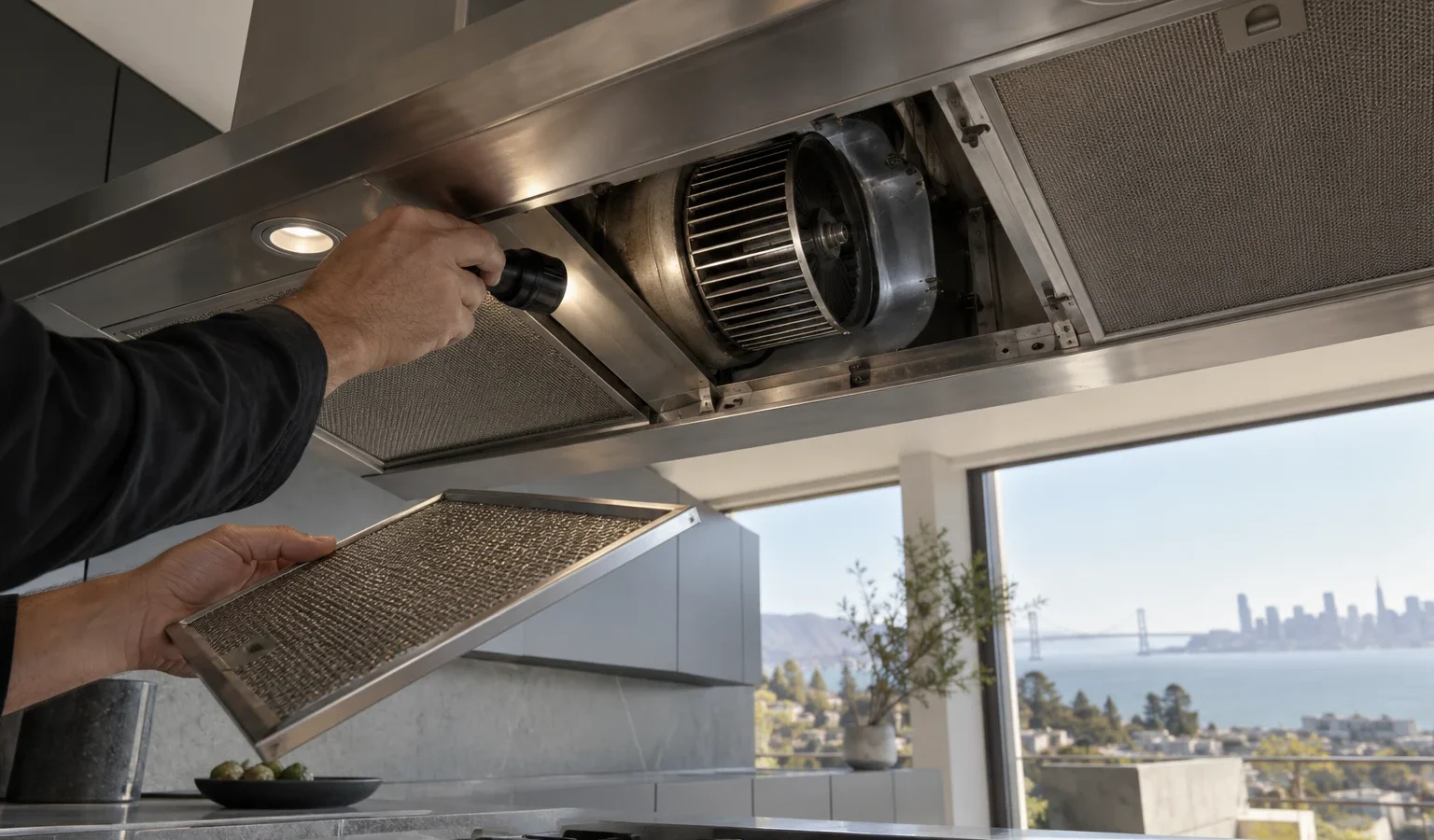
Weak performance more often comes from a blocked path than a weak motor. Grease filters saturated with residue, a closed damper, a crushed flexible duct or a blocked roof or wall cap all reduce flow. Steam that lingers near the cooktop even on the highest setting is the usual complaint.
Intermittent running can be a thermal protection device cutting out, a loose connection, or a control problem that worsens as the unit warms. Note whether it happens after a long cooking session or at random.
A hum without rotation suggests a motor that cannot turn, perhaps from a seized bearing or a failing capacitor. Rattling often comes from a loose filter, a blower wheel that has picked up grease, or a duct joint knocking against framing. Scraping from the blower wheel means it should be inspected before further use.
Stop there. Do not remove the motor housing, test the wiring or open the control cover.
Ducted hoses send air outside, and the duct run matters. A long run with several bends, a cap that has rusted or collapsed, or a cabinet that was built around the duct can all choke the airflow. Recirculating hoods filter the air and return it to the room, so their performance depends on the filter condition and on how the unit was fitted. The diagnosis differs between the two, which is why it helps to say which kind you have when you book.
Island hoods hang from the ceiling and carry their cable and duct through a chimney that is hard to reach. Wall hoods are easier to see but often have a rigid duct that disappears into the wall. Under-cabinet and slim-profile hoods fit tightly, and a duct pinched by a cabinet shelf can ruin performance without leaving any visible sign. In San Francisco flats with a shared exterior wall, the exhaust may exit through a narrow vent that was sized for an older hood and then replaced.
A hood placed over a high-output gas or induction cooktop is also asked to do more. If the hood was swapped for a newer one without checking the duct, the symptom can be a fan that runs hard but clears little. Technicians will compare the duct to the hood’s requirements before suggesting a motor replacement.
If you smell gas at any time, leave the home, avoid switches, and call the gas utility or 911 from outside.
Motors, controls and filters are not interchangeable across hood designs. The model label is usually behind the grease filters or on the inside edge of the hood body, and our guide to finding your Miele model number covers where to look. The hoods we list include the DA 2628, a 46-inch unit, and the DA 3466, a 24-inch unit, and each has its own page.
We start by asking what the hood did and when the change began. Then we check the supply and controls, inspect the blower and motor, and look at the duct path where we can reach it. You get a written estimate before any repair and nothing is replaced without your approval. Learn more about what we handle on the Miele range hood repair page, or browse the full range on Miele range hoods.
Not necessarily. The same symptom can come from a failed capacitor, a relay or a control board that is not calling for the fan. A technician tests these before recommending a motor.
Look at the filters and the duct first. Saturated filters or a restricted duct reduce airflow far more often than a weak motor does.
Yes, as the manual describes. That is a normal owner task. Opening the housing to reach the motor or wiring is not.
It may be a thermal cutout, a loose connection or a control problem. Note how long it runs and whether it follows heavy cooking, then tell the technician.
Yes. Island, wall and under-cabinet hoods have different ducting and access, and recirculating models rely on filters instead of an exhaust duct.
Share a few details and we’ll confirm an appointment. Prefer to talk? Call us and we’ll help right away.