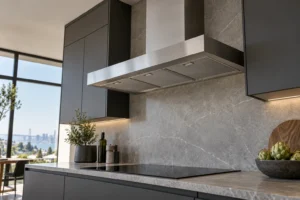
Range Hoods
Island and wall hoods from Miele in Bay Area kitchens: the models we service, why they weaken or go quiet, and what…

Specialized Miele Appliance Repair in San Francisco
Mon–Sat: 8:00 AM – 7:00 PM
When a hood stops clearing the air, the fault can be the motor, the filters or the duct. We trace it before repairing.
Miele repairSan Francisco Bay Area
A hood is the appliance people ignore until the kitchen smells of last night’s dinner. We repair Miele ventilation hoods in San Francisco and around the Bay Area: wall-mounted, island and ceiling-linked designs, whether they send air outside or filter it and return it to the room.
If nothing happens when you press the button, the cause may be a tripped breaker, a failed control board, a loose connector or a motor that has given up. A fan that starts and then sounds labored or moves little air usually has a different story: greasy filters, a blocked duct, a damper stuck closed or a blower wheel loaded with residue. Our article on a Miele range hood fan that is not working covers the order in which to look.
Dead lamps, buttons that stop responding, a remote that no longer connects and a display that shows something unusual all belong in this group. Lamp failure is often simple, but a light circuit that keeps failing points to a driver or a connection that needs inspection.
Whistling usually means air is being forced through a restricted path. Rattling can come from a loose filter, trim or duct joint. A grinding or humming sound that changes with fan speed belongs to the motor or its bearings. Any of these gets worse the longer the hood is run, so it pays to note when it started.
Grease dripping from the hood, a stale smell when it runs or condensation on the housing suggests a filter or duct problem, or in a recirculating setup a carbon filter that no longer does its job. Hot steam hitting the wrong surface can also damage cabinetry nearby.
Where the hood sits and how it breathes decides most repairs.
Hoods over gas cooking collect more grease and heat than most. If the cooking surface below is also acting up, our Miele cooktop repair and Miele range repair pages describe that equipment.
A visit begins at the filters and the controls and then works along the air path. We look at the filter condition and seating, the lamp and control response, the blower wheel and motor behavior, the damper, the visible duct sections and the termination outside. Where the hood is ducted, we watch how it moves air as the speed changes, because a restriction behaves differently from a failing motor. We keep notes on what we saw so the written estimate matches the findings.
Never open the housing, test the motor leads or reach into the blower while the hood is connected to power.
You smell burning plastic or an electrical odor, see smoke, hear scraping from the blower, notice grease dripping onto the cooktop or find that the housing is hot to the touch away from the cooking area. Power it off at the breaker. A hood that is not moving air should not be used over open flame, because heat and grease stay in the cooking area.
Miele hoods differ in housing, motor, filter type and control. The right blower, lamp or board depends on the exact label. It is usually found behind the grease filters, inside the housing, so you may need to remove the filters to read it. Our short guide on finding a Miele model number shows where to look on other appliances too. A photo of the label saves a trip.
You tell us the model, the symptom and how the hood is installed. We diagnose before repair, give you a written estimate and make no repair without your approval. Appointments are Monday to Saturday, 8:00 AM to 7:00 PM. In a building with a ladder-only or restricted roof access to the exhaust cap, let us know in advance.
For the lineup and common complaints, read the Miele ventilation hood guide.
Most often the air path is restricted: saturated grease filters, a blocked duct or a stuck damper at the outside cap. A recirculating hood can also have an exhausted carbon filter. Clean the filters first, then book a diagnosis if there is no change.
A simple lamp swap with the hood switched off at the breaker and cooled down is something many owners do. If the new lamp fails again or the lights flicker, the supply to the lamps needs a technician.
Not necessarily, but noise is a warning. A restricted duct, a loose filter or a worn motor bearing can all be the reason. Note when the sound changes with speed and mention it when you request a visit.
Yes. We check the filters, the blower, the controls and, on ducted systems, the visible duct and the outside cap. Recirculating hoods get the same attention with a focus on filter condition.
Whether the hood is wall, island or built into cabinetry, where the duct exits, and whether the building limits access to the roof or exterior wall. Tell us the model number too if you can find it behind the filters.
Island and wall hoods from Miele in Bay Area kitchens: the models we service, why they weaken or go quiet, and what…
Water, brew unit, milk system or heating: we trace what stopped your Miele built-in or countertop coffee machine in San Francisco and…
Gas, electric and induction Miele cooktops and rangetops diagnosed in San Francisco and the Bay Area: igniters, zones, sensor controls, cooling fans…
Miele dishwasher diagnosis in San Francisco and the Bay Area: draining, water intake, pump, door and dispenser faults, with a written estimate…
Miele dryers that run damp, stop with a fault message or refuse to start get a diagnosis first. We serve San Francisco…
Share a few details and we’ll confirm an appointment. Prefer to talk? Call us and we’ll help right away.