


Specialized Miele Appliance Repair in San Francisco
Mon–Sat: 8:00 AM – 7:00 PM
Water container will not seat, empties too fast, or the oven keeps asking for a refill? Here is what those symptoms usually point to and what to check from the outside.
Miele repairSan Francisco Bay Area
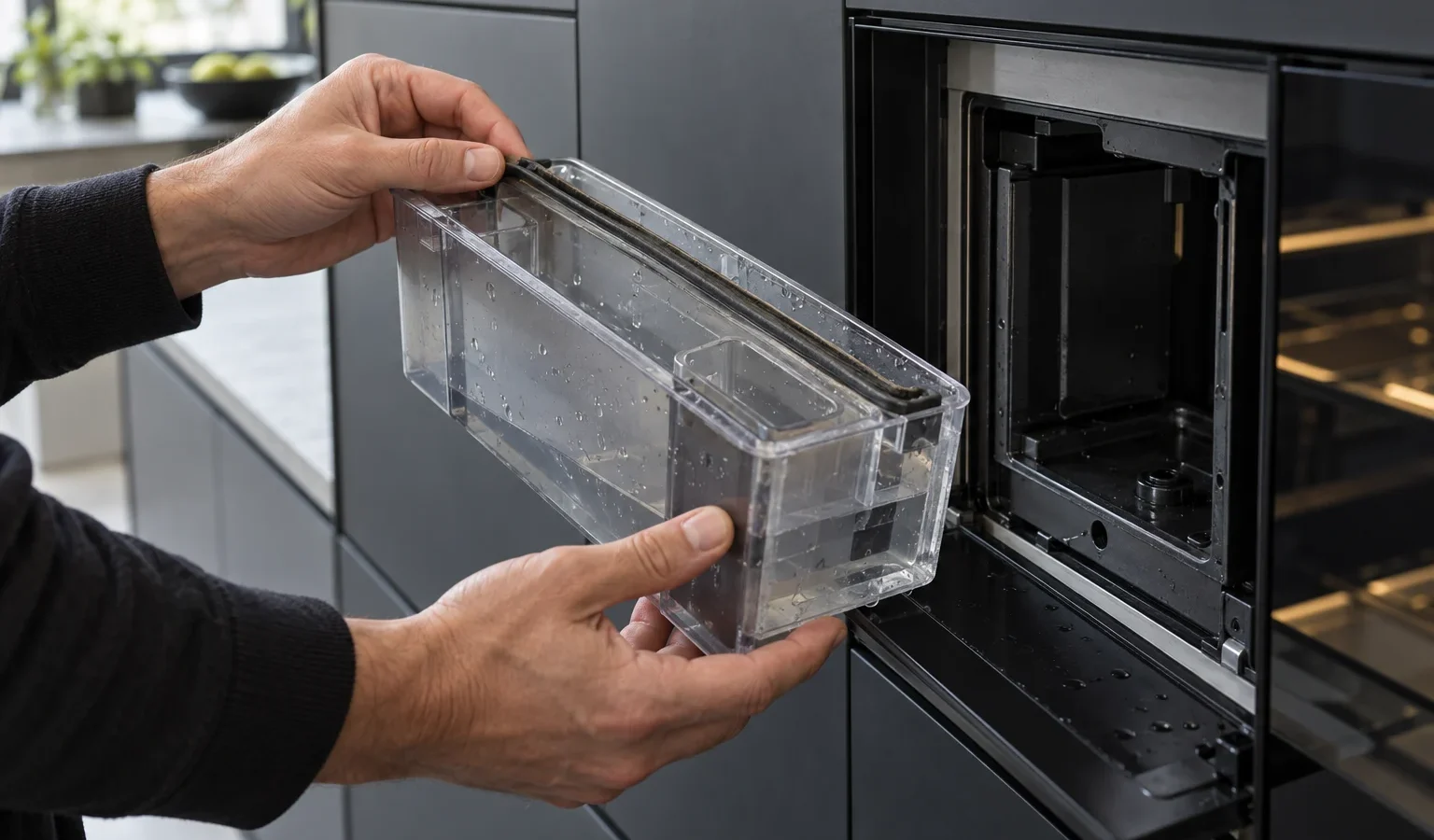
The water container on a Miele steam or combi-steam oven is the part you handle most, so it is also the first place people look when something goes wrong. A container that rattles, drips, or triggers a refill message every few minutes can be a simple seating or cleaning matter, or it can be a sign that the water path behind it has started to scale up. Sorting out which one you have saves a lot of guessing.
In a built-in steam oven the container sits in a recess at the front of the unit, usually behind a flap or at the edge of the control panel. A small pump draws water from it into a steam generator, and when a program ends the oven can pump leftover water back. The container therefore has to seat fully so the oven senses it, connects to its inlet, and holds its level without leaking into the recess. When any of those three things fails, the oven stops cooking with steam or refuses to start.
Take the container out, look at the connector on its back edge and at the recess behind it, and refit it with a firm, even push. Debris, a folded seal or a hairline of dried scale on the connector can stop it from seating. If the oven reports that the container is absent right after you switch it off, that matches the meaning given for code F1, where the container for residual water pumping is not in the appliance.
Slow filling points toward the intake side. The published meanings for F10, F12 and F14 all describe water failing to reach the oven or the steam generator in sufficient quantity, and F10 specifically lists a feed pump that has dried out, a suction hose problem, or osmosis water. Osmosis or very soft filtered water is worth mentioning to the technician if you fill the container from a special tap.
If the oven compartment or generator is still wet hours later, the drain side is the suspect. F11 describes water that cannot leave the steam generator because of limescale or blocked hoses, and F196 describes water that could not be pumped away from the compartment on DGC 6xx0 ovens.
Dampness under the container recess can come from a worn seal, a hairline crack, an overfilled container or a connector that is not seated. Dry the area, refill to the marked level only, and watch where the first drop appears. A leak that returns after you have dried and refitted everything should be seen before the cabinet beneath absorbs the moisture.
Some combination steam ovens use float switches in the container. F94 is listed for float switches that are stuck, and F95 for a level switch blocked by limescale. Both usually show up as a refill message even though the container is full, or the opposite.
If the oven has an automatic descaling reminder, take it seriously. A container problem that appears alongside a reminder is often a scale problem in disguise, and the oven manual describes the descaling routine for your model. Our guide on how to descale a Miele steam oven covers what that routine involves and what the progress indicators mean.
Hard tap water leaves scale on the nozzle, level sensors and hoses much faster than soft water, and that scale is what turns a healthy container into a nuisance. Tell the technician what you fill the container with, and whether the oven has been left unused for long stretches, since a feed pump that dries out is a recognized cause for some water-inlet faults.
Built-in steam ovens sit in a cabinet cutout, and that cutout hides most of the water path. A unit installed in a tall column behind a panel-ready door, or stacked above another oven, is harder to inspect without drawing it out of the housing, and a technician may need to plan access before the visit.
The model number tells the technician which container design and which generation of water path to expect. You will usually find it on the oven frame behind the door. Our walkthrough on finding your Miele model number shows the common label spots. Models on our site such as the DGC 7440 XL, the DG 6500 and the DG 4084, which is no longer sold new, each have their own page.
Book when the same water message comes back after a clean, refill and one reset, when water remains in the compartment, when the cabinet below is damp, or when the oven stops making steam altogether. For a full picture of what we repair on these ovens, see Miele steam oven repair, and for the lineup itself, Miele steam ovens.
The visit begins with diagnosis. We look at the container, connector, pump, hoses and generator for the symptom you describe, then give you a written estimate. Nothing is repaired until you approve it.
A container that is full but still flagged often has a level or float problem, or it is not fully seated so the oven cannot read it. Re-seat it first. If the message persists, a scaled level switch or stuck float is likely and needs a technician.
Plain fresh water is what the container is meant for. Osmosis water is specifically mentioned in the meaning of code F10, so mention any filtered or treated water to the technician if a water fault appears.
Some condensation around the recess can be normal, but dripping that reaches the cabinet is not. Check for an overfilled container or a seal that has shifted, and book a visit if it recurs.
It is better to stop. A water fault can leave water in the generator or compartment, and further programs may not clear it. Switch off, note the message and arrange a diagnosis.
A long idle period can dry out the feed pump, which is one of the causes listed for the F10 water inlet fault. If the oven has been idle and now will not draw water, say so when you book.
Share a few details and we’ll confirm an appointment. Prefer to talk? Call us and we’ll help right away.