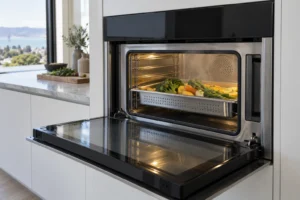
Steam and Combi-Steam Ovens
What goes wrong with Miele steam and combi-steam ovens in the Bay Area: water and descaling faults, codes, label location and checks…

Specialized Miele Appliance Repair in San Francisco
Mon–Sat: 8:00 AM – 7:00 PM
When a steam oven stops on a water or level message, the cause is usually in the supply, the drain or the scale, and we check those first.
Miele repairSan Francisco Bay Area
Steam and combi-steam ovens are among the most water-dependent appliances in a kitchen, so most faults trace back to where the water comes from, where it goes and what limescale has done along the way. We diagnose and repair Miele steam ovens and combination steam ovens in San Francisco and around the Bay Area. You get a diagnosis before repair, a written estimate and no work without your approval.
Steam needs a steady supply. When the oven cannot draw in water, it stops the programme and shows a message. The cause might be a container that is not seated, a valve that is not fully open, a scaled nozzle or a feed pump that has dried out. Osmosis water is also known to cause intake problems, which surprises owners who have fitted a softening or filtering system. Our article on steam oven water container problems covers the first steps.
The steam generator drains between uses, and blocked hoses or limescale stop that. The oven may also fail to pump residual water from the compartment, or report that the container is missing at switch-off.
A compartment that does not warm in the expected window triggers its own message, and so does a compartment that gets too hot. These point at the heating elements, the sensors and the limiter circuit. A technician measures behaviour rather than guessing at a part.
Limescale blocks level switches and sticks float switches in the water container, and that is behind a number of intake and level messages. If your descaling routine has slipped, expect scale to be part of the story. Our guide to how to descale a Miele steam oven sets out the owner routine.
Record the code before you do anything else.
Descaling progress shows as E0 through E5, which are stages, not errors. The error codes page lists the rest.
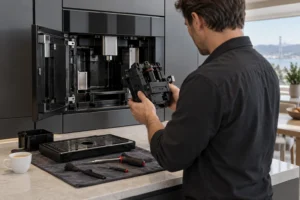
Many steam ovens sit in a tall cabinet or above a warming drawer, with a container behind a flap or a plumbed supply running into the cabinet. Those details decide how we diagnose. A plumbed unit needs its shutoff valve found and opened, its hose checked for kinks and its filter or softener considered. A container-fed unit needs a seated container, a clean intake and a clear path for residual water. Bay Area water varies from soft to noticeably hard depending on where you live, and the scale a steam oven collects reflects that. Cabinet clearance matters as well: removing a unit from a tight cutout requires room and a clear sight line to the connections behind it.
If your oven can also cook with dry heat, the wall oven repair page covers those faults.
Do not remove covers, do not run a descaling programme to cure a fault that has not been diagnosed, and do not open the oven while it is making steam. A burning smell, sparks or a hot housing mean power off at the breaker.
The label is usually on the frame behind the door, and the type shown there tells the technician whether you have a steam oven or a combi-steam oven. Our help page on finding the model number shows how. We regularly see the DGC 7440 XL, the DG 6500 and the retired DG 4084, which is no longer sold new. See the Miele steam oven guide for the lineup.
Most steam oven faults repeat when the cause was scale and the routine never changed. Empty the container after cooking instead of leaving water standing, leave the door ajar for a while so the compartment dries, and wipe the gasket where condensation gathers. Descale when the oven asks for it rather than waiting until a water message appears, and let the programme run to the end without cutting power. If your home uses a water filter or a softener, mention it at booking, because the type of water changes which intake messages are plausible.
You send the label, the code and a description of what the oven did. The technician checks the water route, the drain and the heating, then explains the finding. A written estimate follows, and the repair starts only when you approve it.
No. The E-series messages E0 to E5 are stages of a descaling programme, not faults. Let the programme finish. A power cut during descaling is different and does produce its own message.
Water intake messages can come from an empty or poorly seated container, a valve that is not fully open, a scaled nozzle or a feed pump that has run dry. The container and supply checks come first, then a technician tests the pump and valve.
Yes. Plumbed units add a water supply, a shutoff valve and sometimes a drain connection, so we check those connections as part of the diagnosis. Knowing whether yours is plumbed or uses a container helps us plan.
They do. Float switches tell the oven how much water is present, and a switch stuck or blocked by limescale produces level-related messages. Rinsing and descaling the container as the manual describes helps, but a stuck switch needs inspection.
The model label from the frame behind the door, the exact code, whether the oven is plumbed, and when you last descaled. If the oven is one of the retired models, say so, since parts planning differs.
What goes wrong with Miele steam and combi-steam ovens in the Bay Area: water and descaling faults, codes, label location and checks…
Water, brew unit, milk system or heating: we trace what stopped your Miele built-in or countertop coffee machine in San Francisco and…
Gas, electric and induction Miele cooktops and rangetops diagnosed in San Francisco and the Bay Area: igniters, zones, sensor controls, cooling fans…
Miele dishwasher diagnosis in San Francisco and the Bay Area: draining, water intake, pump, door and dispenser faults, with a written estimate…
Miele dryers that run damp, stop with a fault message or refuse to start get a diagnosis first. We serve San Francisco…
Share a few details and we’ll confirm an appointment. Prefer to talk? Call us and we’ll help right away.