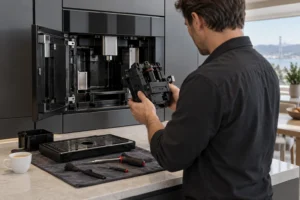
Coffee Machine Repair in San Francisco
Water, brew unit, milk system or heating: we trace what stopped your Miele built-in or countertop coffee machine in San Francisco and…

Specialized Miele Appliance Repair in San Francisco
Mon–Sat: 8:00 AM – 7:00 PM
From scale to blocked grinders, most morning failures leave a clue on the display.
Miele repairSan Francisco Bay Area
Coffee machines work harder than most kitchen appliances: grinding, heating, pumping, frothing, rinsing, all before breakfast. Miele makes both countertop machines and units built into the cabinet wall, and San Francisco owners tend to rely on them every morning. When one stops, the cause is often scale, a blocked passage or a brew unit that is out of position. Our Miele coffee machine repair service is where to turn when the checks here are not enough.
All five coffee machines we cover are countertop models: the CM 5300, CM 5310, CM 5510, CM 6150 and CM 6160. They are current models. Built-in machines also reach us; their codes are noted on the individual code pages, and a few messages apply to one type only.
On a countertop machine the label is usually behind the front cover or on the base once the drip tray and water tank are removed. On a built-in unit it is typically behind the front cover as well. Photograph it so the full line is readable.
Our guide on a coffee machine not brewing goes through the usual order, and how to descale a Miele coffee machine explains the routine that keeps passages open.
F10 means no water is being drawn in on countertop machines, and F17 says fresh water is not reaching a built-in machine properly. F28 points to too much ground coffee in the brew unit or a blocked grinder channel. F73 means the brew unit cannot reach its start position or is soiled, and on capsule models the capsule is not seated. F75 and F76 indicate a jammed capsule.
F233 concerns the cup rim sensor on built-in machines, which may be soiled or fitted wrongly. F307 is a clogged milk valve, and F74 is a valve adjustment fault where the valve may need descaling. Heating system problems appear as F1 through F4, plus F80 to F83, and F0 is an electronic module fault. Heating and electronic codes are not an owner fix.
Many faults trace back to routine. Beans left in the hopper for weeks, an unrinsed milk line, a water tank that is never emptied, and a drip tray that overflows into the base all shorten the time between problems. A machine on a busy counter near the sink also collects splashes, so keep the cup-rim area and the front cover dry and wiped.
Do not pry open housings or force a stuck brew unit, and do not use descaler in a way the manual does not allow. Hot water and steam can burn.
Book a visit through the coffee machine service page. We diagnose first, share a written estimate, and repair nothing until you approve it. You can also browse our other Miele appliance guides.
It depends on how much you brew and on your water. Follow the machine’s prompts rather than ignoring them, since scale slows flow and stresses the heating system.
Grounds may be clogging the chute, or the brew unit may not be in its start position. Cleaning the removable parts helps, and persistent trouble needs inspection.
Use the cleaning method your machine expects, and rinse until no residue remains. Dried milk is a common cause of clogged valves.
Access is different. A built-in unit sits in a cutout and may need to be drawn forward carefully, while a countertop machine can be moved to a bench.
Write down the exact text and photograph the screen. Do not try reset sequences from the web; we will identify it during diagnosis.
Water, brew unit, milk system or heating: we trace what stopped your Miele built-in or countertop coffee machine in San Francisco and…
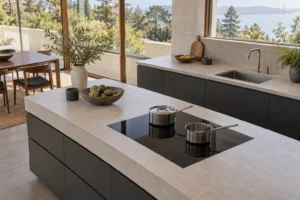
Induction, electric and gas cooktops, CombiSets and rangetops from Miele: sizes we service, common faults, display codes and safe checks.
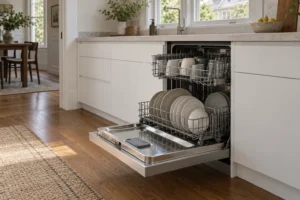
What San Francisco owners should know about Miele dishwashers: models we list, where the label is, drain and leak complaints, display codes…
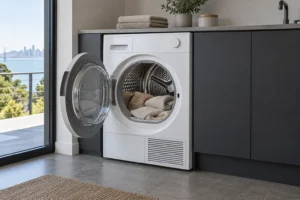
A San Francisco guide to Miele dryers, including heat-pump units: models we list, label location, slow drying complaints, display codes and checks…
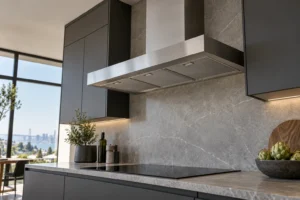
Island and wall hoods from Miele in Bay Area kitchens: the models we service, why they weaken or go quiet, and what…
Share a few details and we’ll confirm an appointment. Prefer to talk? Call us and we’ll help right away.