


Specialized Miele Appliance Repair in San Francisco
Mon–Sat: 8:00 AM – 7:00 PM
When a Miele coffee machine grinds, hums or lights up but delivers nothing, water, the brew unit or a valve is usually the culprit. See the checks that come first and when to call.
Miele repairSan Francisco Bay Area
Nothing feels worse than a morning ritual that ends with an empty cup. A Miele coffee machine that will not brew can fail in several ways: the display lights up but no water moves, the grinder runs and no coffee follows, a message interrupts the cycle, or the cup fills with a weak trickle. Each pattern points to a different part of the machine, so it helps to describe what you actually see.
Naming the pattern before you start is worth a minute, because the checks below differ for each.
No water is the most common reason for no coffee. On a countertop machine, check that the water container is filled and fully seated and that the connector at its base is clean and not obstructed. Miele describes code F10 as no water being drawn in, a message listed for countertop machines. On a built-in machine, a plumbed line or a connected fresh-water supply can fail without the display giving much warning, and Miele describes F17 as fresh water not reaching the machine properly, listed for built-in coffee machines. For a built-in unit with a water line, check that the supply valve is open and the line is not kinked.
Scale is a common, quiet culprit. Hard mineral deposits narrow the water path and slow the flow, particularly after months without descaling. Miele describes F74 as a fault during valve adjustment, noting the valve may need descaling. Our guide on how to descale a Miele coffee machine explains the routine to follow.
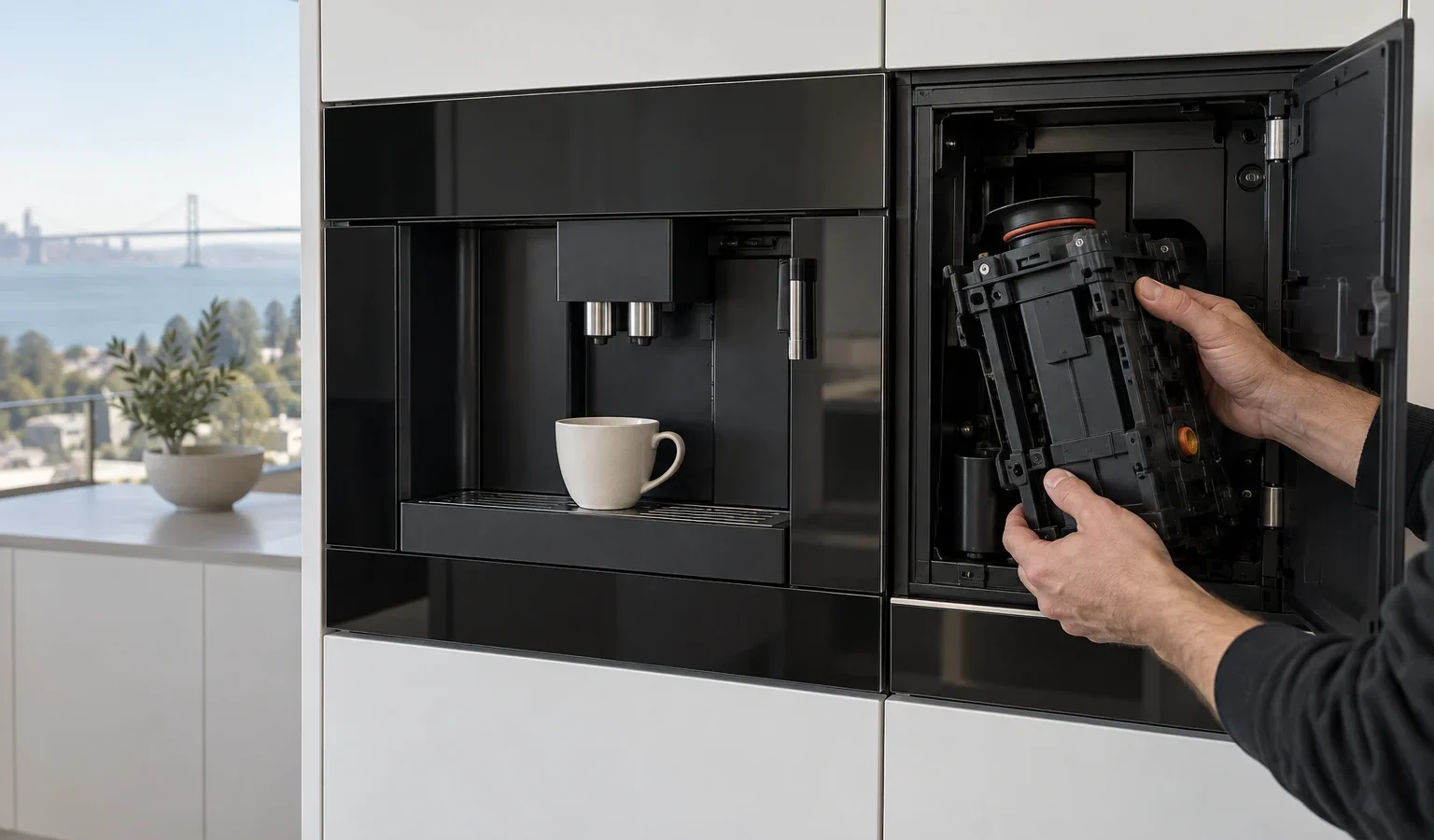
When water is fine but no coffee arrives, the brew unit is the next suspect. Miele describes F73 as the brew unit being unable to reach its start position or being soiled, and for capsule models as a capsule not seated; it is listed for built-in machines of the CVA 2xxx to 7xxx range. Capsule machines can also report a jam; Miele describes F75 and F76 as a jammed coffee capsule.
Too much coffee can also stop a machine. Miele describes F28, with the prompt to clean the brew unit by hand, as too much ground coffee in the brew unit or a blocked grinder channel. That tends to follow very oily beans or a hopper that has gone untouched for weeks.
If plain coffee works and milk drinks fail, look at the milk path. Miele describes F307 as a clogged milk valve. Dried milk is sticky and builds up in the valve faster than most owners expect, which makes regular rinsing important.
Miele also lists several valve initialisation errors, including F226, F352 and F77. Those come with a stuck or scaled valve more than with a user error, and they are a signal to stop and book service.
A built-in machine can refuse to dispense if its cup sensor is dirty or misplaced. Miele describes F233 as a cup rim sensor that is soiled, missing or incorrectly fitted, or a container that sits too far back or is too wide. Wipe the sensor area with a soft damp cloth and check the cup placement.
Heating faults are different. Miele lists F1, F2, F3 and F4 as heating system problems, and F0 as an electronic module fault. These are not owner repairs. Write the code down, switch the machine off, and arrange diagnosis.
Do not force the brew unit back in, push beans through a blocked grinder, or pour boiling water into any opening. Do not use descaler without following the machine’s instructions, since a half-finished programme can leave residue in the water path. Do not open the cabinet or touch internal wiring. Switch the machine off at the plug or breaker if you notice a burning smell or any sparking.
Built-in machines sit flush in cabinetry, often beside an oven or a warming drawer, and the heat and steam from neighbors can play a part. Plumbed units rely on a supply line that is easily kinked when the machine is slid back into its niche. If your coffee machine was moved or the cabinet was changed, mention it when you book. For a countertop unit such as the Miele CM 5310 or Miele CM 6160, the usual issues are the water container seat, the brew unit and scale.
Book when a code returns after a power reset, when there is a heating or valve message, when water leaks under the machine, or when descaling does not fix the flow. Read about Miele coffee machine repair or browse the Miele coffee machine lineup. Our guide to finding the model number helps, and you can reach us through the contact page anywhere in San Francisco and the Bay Area. We diagnose first, provide a written estimate, and repair nothing without your approval.
The brew unit may be soiled or not at its start position, or the grinder channel may be blocked. Miele ties several of its brew unit messages to exactly these causes.
It can when scale has narrowed the water path or stuck a valve. Follow the machine’s own programme from start to finish, and book service if the problem remains.
Reseat the container, check its connector for debris, and look for a trapped air pocket by refilling gently. If the message returns, a pump or valve may need diagnosis.
Often it follows dried milk residue, so rinse the milk system as the manual describes. If the message stays, the valve needs a technician.
The model number, the exact display message, whether the machine is built-in or countertop, and what you have already cleaned or descaled.
Share a few details and we’ll confirm an appointment. Prefer to talk? Call us and we’ll help right away.