Coffee Machines
Countertop and built-in Miele coffee machines in San Francisco homes: models we list, label location, brewing and water faults, display codes and…

Specialized Miele Appliance Repair in San Francisco
Mon–Sat: 8:00 AM – 7:00 PM
A brew unit that jams, water that never arrives or a milk message that will not clear: we find where the fault sits and tell you plainly.
Miele repairSan Francisco Bay Area
A coffee machine fails in small, annoying ways: water that will not come through, a brew unit that jams, milk that will not froth, a message that returns each morning. We diagnose and repair Miele built-in and countertop coffee machines across San Francisco and the Bay Area, and we begin by working out whether the fault sits in the water path, the brew unit, the milk system or the electronics.
If the machine draws no water or reports that fresh water is not arriving, the cause may be as simple as an empty or badly seated tank, or as involved as a scaled valve. On built-in machines the supply line and its valve are part of the picture. Our troubleshooting article on a Miele coffee machine not brewing sets out the sequence we follow.
The brew unit is the moving heart of the machine. Too much ground coffee, residue or a unit that cannot return to its start position stops the cycle. Capsule machines add a second failure, a capsule that is not seated or has jammed in the chamber.
Several heating system messages exist, and they matter because a machine that cannot heat cannot brew properly. A technician reads which one is shown and checks heating components accordingly.
Milk lines and valves are narrow, and dried milk blocks them. A clogged milk valve is listed as the meaning behind one of the common messages.
Water in the drip tray beyond what is normal, or damp cabinet behind a built-in unit, deserves attention quickly. Switch the machine off and keep the area dry while you wait for a diagnosis.
The display text is the first thing to record. These entries have documented meanings:
Messages such as F1, F2, F3 and F4 are all described as a heating system problem, while F226, F352 and F77 are valve initialisation errors. Browse everything in the error codes page.
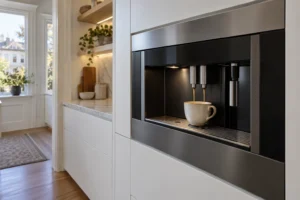
A countertop machine stands on your worktop, takes water from a tank and can be carried to wherever it is easiest to test. A built-in machine is different: it sits flush in a cabinet or a tall housing next to a wall oven or a warming drawer, and some are connected to a plumbed water line. For those, we look at the supply valve, the hose connection, the trim around the front and the room behind the unit before touching the machine. Clearance is tight in many European-style Bay Area kitchens, and a unit that cannot be slid forward needs a different approach from one that can.
Hard water leaves its mark on both types. Limescale builds up in valves, heaters and narrow channels, and that is why descaling messages and valve faults tend to appear together. Our guide to how to descale a Miele coffee machine covers the owner routine.
Do not remove the front cover on a built-in unit, do not force the brew unit, and do not run the machine if you can see water where it does not belong. Any burning smell or sparks means power off at the breaker.
Countertop and built-in machines share a family name but differ in construction, so the label decides which parts and checks apply. It is usually behind the coffee machine front cover or on the underside, and on some units it is visible once the water tank is removed. Our page on finding the model number helps. Machines we handle include the CM 5300, the CM 5510 and the CM 6160, all listed as countertop machines. The broader Miele coffee machine guide shows the full lineup.
Send us the label and the message. The technician tests the water path, the brew unit and the heating response, then explains what failed. A written estimate follows, and nothing is repaired until you agree to it. Where the answer is a rinse or a descaling run, we tell you how to do it.
Grinding with no output usually means the brew unit, a clogged outlet or a water-supply problem rather than the grinder. The brew unit may be soiled or not at its start position, and limescale can narrow the water path. A technician checks the brew unit and the water route in sequence.
Yes, the routine descaling programme is an owner task and often prevents calls about slow water and valve faults. Follow the prompts on the display and do not interrupt it. If a descaling progress message stalls or the machine reports a valve problem afterwards, that is the point to book a visit.
The checks are similar, but the setting is not. A built-in unit sits flush in a cabinet or tall housing and may be on a plumbed water line, so the technician needs access to the front and to the supply. A countertop machine can usually be brought to a clear surface and tested there.
Milk residue dries inside narrow channels and valves, and a clogged milk valve is a known cause of frothing failures. Regular rinsing helps, but a valve that stays blocked needs a hands-on inspection.
The model label, the exact display message, whether the machine is plumbed or filled from a tank, and what you last did to it, such as descaling or moving it. A photo of the message is handy.
Countertop and built-in Miele coffee machines in San Francisco homes: models we list, label location, brewing and water faults, display codes and…
Gas, electric and induction Miele cooktops and rangetops diagnosed in San Francisco and the Bay Area: igniters, zones, sensor controls, cooling fans…
Miele dishwasher diagnosis in San Francisco and the Bay Area: draining, water intake, pump, door and dispenser faults, with a written estimate…
Miele dryers that run damp, stop with a fault message or refuse to start get a diagnosis first. We serve San Francisco…
Miele gas, dual fuel and induction ranges serviced in San Francisco and the Bay Area, from ovens that will not heat to…
Share a few details and we’ll confirm an appointment. Prefer to talk? Call us and we’ll help right away.