Dryer Repair in San Francisco
Miele dryers that run damp, stop with a fault message or refuse to start get a diagnosis first. We serve San Francisco…

Specialized Miele Appliance Repair in San Francisco
Mon–Sat: 8:00 AM – 7:00 PM
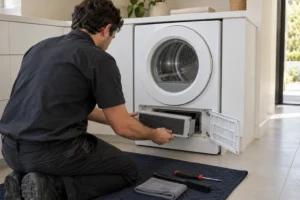
Slow drying usually starts with lint and airflow, so begin with the filters before you suspect a part.
Miele repairSan Francisco Bay Area
A dryer that takes twice as long, or stops with a code and a wet load, is a common reason for a call from San Francisco households. Many Miele dryers here are heat-pump units installed without an outdoor vent, which changes what goes wrong. They depend on clean filters, free airflow and a working refrigerant circuit instead of a flue to the outside. Our Miele dryer repair service is built around that difference.
We cover five dryers. The PDR 908 HP sits in the professional-style group. The TWB120 WP, TWF160 WP, TWI180 WP and TXB 360 WP are the others. All are current models. We make no size or capacity claims about them here; the label and a quick look settle that.
The label is usually on the door rim or along the inside of the door opening. A dryer stacked above a washer is easy to read once the door is open, though a plinth filter or drawer may hide part of it.
Long cycles are covered in our article on a dryer that takes too long, and the habits that keep a heat-pump unit healthy are in heat-pump dryer filter care. Most slow-drying problems begin with lint, not with a failed part.
F66 usually means the fluff filters or the plinth filter are not cleaned or are too wet, with overload or a blocked vent also possible. F55 says laundry is still damp after the maximum drying time. F50 means the drum is too full, and F158 reports that the appliance has overheated.
Sensor codes point to the refrigerant side: F1 and F2 concern the refrigerant temperature sensor, F156 and F157 the sensor downstream of the condenser, and F159 is a compressor start-up fault. Door contact trouble appears as F30 or F36. F104 reports low mains voltage at the drive motor.
A heat-pump dryer needs room to breathe. Pushed hard against a closet wall, or stacked with the door of a louvered cabinet closed, it recirculates air that is already humid and drying slows. Where a vent hose is fitted, a long run or a crushed bend behind the machine has the same effect. The technician looks at the space around the unit and at the condensate path as well as the machine itself.
If you smell something burning or see sparks, switch the dryer off at the breaker. Do not open the cabinet, and never run the machine with a blocked filter.
If the clean filter and lighter load do not help, request a visit via the dryer repair service. We diagnose first, give a written estimate, and repair only with your approval. Owners with a pair should also read the washer guide.
Heat-pump dryers dry with warm, dehumidified air, so warm is normal. Hot air with a long cycle, or no warmth at all, is a different matter that deserves a check.
Check it regularly and clean it whenever it holds lint or feels wet. F66 is often tied to filters that were left dirty.
It needs a path for air to move, so a closed closet with no gap can lengthen cycles. Leave a clear opening and keep the area free of stored items.
It means the appliance protected itself. Switch it off, let it cool, clean the filters and try again once; if it recurs, book a diagnosis.
Yes. The unit above the washer is harder to reach, so we plan access and tell you if it needs to be separated.
Miele dryers that run damp, stop with a fault message or refuse to start get a diagnosis first. We serve San Francisco…
Countertop and built-in Miele coffee machines in San Francisco homes: models we list, label location, brewing and water faults, display codes and…
Induction, electric and gas cooktops, CombiSets and rangetops from Miele: sizes we service, common faults, display codes and safe checks.
What San Francisco owners should know about Miele dishwashers: models we list, where the label is, drain and leak complaints, display codes…
Island and wall hoods from Miele in Bay Area kitchens: the models we service, why they weaken or go quiet, and what…
Share a few details and we’ll confirm an appointment. Prefer to talk? Call us and we’ll help right away.