


Specialized Miele Appliance Repair in San Francisco
Mon–Sat: 8:00 AM – 7:00 PM
Damp plates and pooled water on cups are usually about rinse aid, loading or the final rinse, not a broken machine. Here is how to sort the cause and fix it.
Miele repairSan Francisco Bay Area
You open the door at the end of a cycle and the plates are cool and beaded with water. Cups have little pools on their bottoms. It is easy to blame the machine, yet drying in a modern dishwasher relies on several things working together, and many of them are within an owner’s reach. Understanding how the machine dries helps you find which part of the chain is letting you down.
Most of the drying in a Miele dishwasher comes from the hot final rinse. Dishes warmed by that rinse shed water as vapor, which condenses on the cooler walls of the tub and runs down the drain. Rinse aid lowers the surface tension of water so that it sheets off dishes instead of forming droplets. Some programs add extra drying time or a fan-assisted step. If any of these stages is weak or skipped, you end up with wet dishes even though the cycle finished.
An empty rinse aid reservoir is the number one reason. Check the reservoir indicator and refill it with the product your manual recommends. The display may remind you, and the meaning of Miele dishwasher F170 is a lack of rinse aid. If the reservoir is full and results are poor, the dose setting may need adjusting. Too little leaves water on dishes, too much can leave streaks and foam.
Short, economy or low-temperature programs skimp on the final rinse and the drying stage. If you recently switched programs, drying may simply have changed. Try a program with a hotter rinse or an extra drying option and compare.
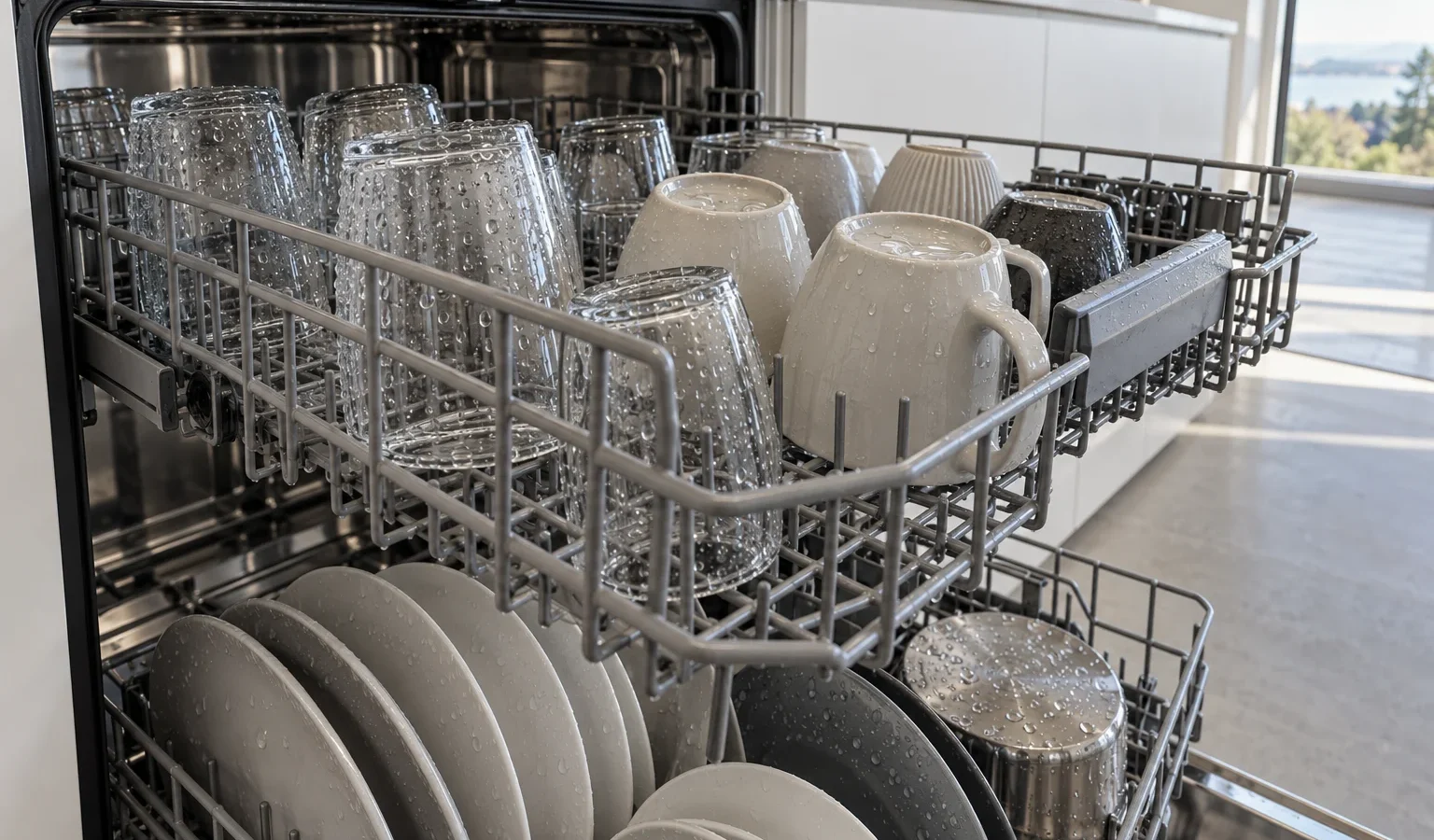
Plastics hold less heat and always come out wetter than glass or china. Cups and bowls tilted upward catch water in their hollows. Nested items trap moisture between them. Leave space, face concave pieces downward and keep tall items from blocking the spray arms.
Many people open the door early to check. Letting steam escape at the end can leave droplets, and a slightly open door can also cool the tub too quickly. If your model has an automatic door opening at the end of the program, let it finish before you reach in.
If water sits in the bottom of the tub at the end of a cycle, steam will not dry anything and the whole interior stays damp. Slow or incomplete draining has its own checklist in Miele dishwasher not draining. Clean the filter, check the visible parts and look at the code list. Water remaining in the cabinet is described at Miele dishwasher F11 for a misplaced non-return valve or blocked drain pump, and Miele dishwasher Drain is the general drain message.
If the machine cannot heat water properly or reads the wrong temperature, the final rinse is cooler than it should be. Heating and sensor faults are listed under codes such as F1 and F2, which refer to temperature sensor circuits, and F24, a heating relay contact fault. The cleaned dishes may also look dull or smell of detergent when heating is weak. A technician measures what the machine is actually doing.
Some machines vent steam through a path in the door or tub. A blocked or obstructed vent traps humid air and lengthens drying. This is difficult to see from the outside. If your machine feels especially damp inside after cycles, mention it at the visit.
Do not open the base panel, test the heater live or add chemicals to force drying. Dishwasher detergents and cleaners should be used as the manual states.
Hard-water spots, a cloudy film and wet plastic are often blamed on the machine when the real cause is how it is used. Use the detergent amount your manual suggests, because too little leaves residue that holds water and too much leaves a film. Scrape rather than rinse plates so the detergent has soil to work on. Avoid stacking bowls inside one another, which blocks both spray and drying.
Integrated machines in tight cabinetry rely on a closed, level tub. A machine that has settled to one side after a remodel can hold water in a corner. A high drain hose or a hose without a proper loop or air gap can let dirty water creep back. Those installation details matter for both drying and cleaning.
Book a diagnosis if drying stays poor after the rinse aid and loading checks, if water remains in the base, if dishes also come out gritty, or if the display shows a heating, sensor or drain code. Have the model label ready, usually on the door edge or inner frame. See the Miele dishwasher lineup page for the machines we service, and a listing such as the Miele G 7516 SCi, a 24-inch dishwasher, shows what details help. The technician diagnoses before repair, gives a written estimate and repairs nothing without your approval. Details are on Miele dishwasher repair.
Plastic retains less heat than china or glass, so water does not evaporate from it as readily. Wet plastic alone is not a fault.
Too much can leave streaks and film rather than wetness, but a wrong dose in either direction affects drying results. Follow the setting your manual describes.
It often does, because it lengthens the drying stage or raises the final rinse. If dishes are still wet with it enabled, look at the heating and drain.
Some moisture is normal immediately after a cycle, as steam condenses. If water remains in the base, the machine is not draining fully and needs attention.
Beads of water on a seal are normal. Wipe it dry, and check that it is clean and seated.
Share a few details and we’ll confirm an appointment. Prefer to talk? Call us and we’ll help right away.