


Specialized Miele Appliance Repair in San Francisco
Mon–Sat: 8:00 AM – 7:00 PM
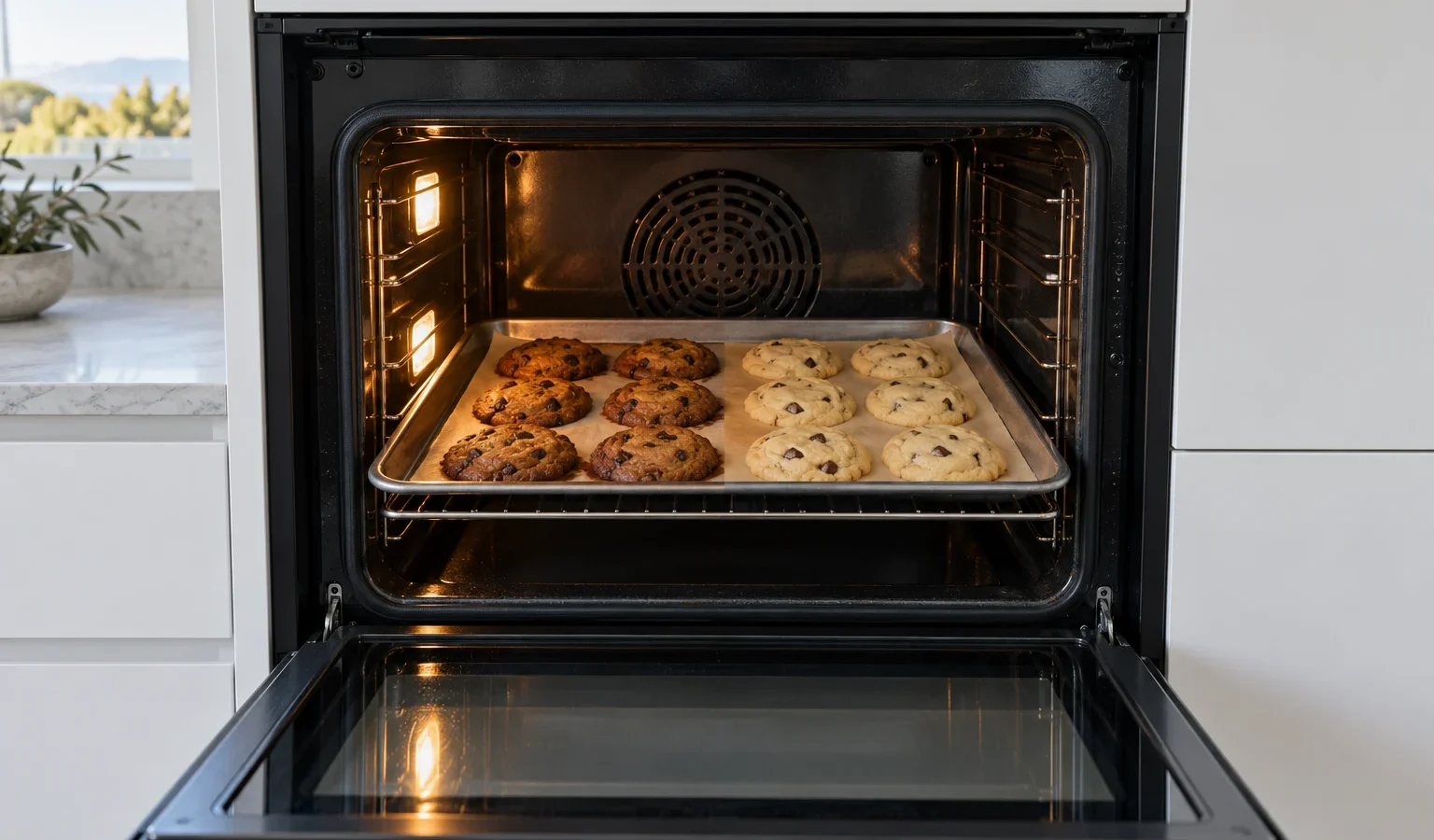
Browned on one side and pale on the other? Uneven heat in a Miele oven can come from loading and mode choices as much as parts. Here is how to sort habit from fault.
Miele repairSan Francisco Bay Area
An oven bakes well when hot air moves evenly around the food. Uneven results come from one of two directions: something is interfering with that airflow or heat, or a part is no longer delivering heat in the way the programme expects. Because wall ovens sit inside tall cabinets, flush with their surroundings, the cavity is well insulated and the problem is often simple.
Pay attention to the pattern, because it tells you where to look.
Many uneven results trace back to the way the oven is used. A tray pushed against the back wall can block air from the fan and cause a hot spot. A large sheet that fills the width of the shelf stops air from rising around it. Foil laid across a shelf, or a pan that covers the whole rack, changes the airflow and shades part of the food. Dark pans absorb more heat than light ones, so two pans of the same dough bake differently.
The mode matters as well. Fan-assisted modes move air around the cavity, while top and bottom heat modes rely on radiant heat from above and below. Using a mode that does not suit the dish gives lopsided results. Check the manual for what each mode is intended for before blaming the oven.
Loading several trays at once is another common culprit. Air needs space around each tray, and the more crowded the oven, the more uneven the cooking.
If the pattern follows the tray, the cause is the loading. If it stays in one corner of the oven regardless of what you bake, the oven itself is more likely involved.
A technician checks the heating elements, the convection fan and its motor, the temperature sensor, the door seal and hinge, the control module, and the cooling fan and air ducts. Several Miele messages relate to these areas. Miele describes F134 as the temperature sensor detecting that the oven compartment temperature is too high, a technical fault. It describes F60 as insufficient appliance ventilation, noting that the air duct may be covered, which is a reminder that the cabinet around the oven matters. A covered duct changes how the oven runs.
Miele also describes F23 as pyrolytic cleaning temperature not reached, often from heavy soiling. Soiling inside the cavity can affect how heat behaves long before a cleaning cycle begins, so a heavily soiled oven deserves cleaning before diagnosis.
An element that has partly failed produces exactly the lopsided heat that annoys cooks. A sensor that reads wrongly can make an oven overheat or underheat, and then correct itself unevenly.
Built-in wall ovens sit in a cutout, and the surrounding cabinet needs to leave air paths open for cooling. A cabinet that has been modified, a shelf added above, or insulation shoved into gaps can restrict ventilation. A speed oven that combines microwave and convection cooking, such as the Miele H 7270 BM, and a conventional wall oven such as the Miele H 7280 BP are different appliances, so name your exact model when you book.
In older San Francisco homes with remodeled kitchens, ovens are sometimes installed in tight cabinets that were cut for an earlier appliance. Slight misalignment can keep the door from sealing evenly. Gaps and tilts are worth mentioning.
Do not use the oven with the door open as a heater, line the floor of the cavity with foil, or pour water into a hot cavity. Do not remove covers, touch heating elements or open the control housing. If you smell gas on a gas range with an oven, leave, switch nothing on, and call the gas utility or 911 from outside. If you smell burning plastic or see sparks, switch the oven off at the breaker and leave it off.
Before the visit, note the mode you use, the temperature you set, the shelf height, the pan type and where the problem shows. A photograph of a browned tray is useful. Tell us whether the problem is new or has crept up, since a gradual change suggests an aging part while a sudden one points toward a failure.
Book when uneven cooking persists with proper loading, when the oven shows a message, when preheating is slow or erratic, or when the door no longer seals evenly. Find the label on the oven frame behind the door, or see how to find your model number. Read about Miele wall oven repair, browse the Miele wall oven lineup, or reach us through the contact page. We diagnose before repair, give a written estimate, and repair nothing without your approval.
No. Tray position, pan color, crowded shelves and the wrong mode all cause lopsided results, so rule those out before assuming a part has failed.
Rotate the tray halfway through. If the browning moves with the tray, loading is the cause; if it stays in the same corner, the oven needs a look.
It can. Insufficient ventilation changes how the oven runs, and Miele has a message for a covered air duct, so keep the cabinet air paths clear.
Remove loose debris and foil, but do not take covers off. Heavy soiling can affect heat, so mention it so the technician knows.
The model number, the mode and temperature used, shelf position, pan type, where it browns unevenly and when you first noticed it.
Share a few details and we’ll confirm an appointment. Prefer to talk? Call us and we’ll help right away.