Wall Ovens and Speed Ovens
Wall ovens, speed ovens and built-in microwaves in Bay Area kitchens: the lineup we see, common faults, display codes and safe first…

Specialized Miele Appliance Repair in San Francisco
Mon–Sat: 8:00 AM – 7:00 PM
An oven that stays cold, holds its door shut or bakes unevenly is checked where it is built in, then explained before any work begins.
Miele repairSan Francisco Bay Area
A Miele wall oven is built into your cabinetry and used daily, so a fault that stops the oven, locks the door or skews the baking is hard to live with. We repair Miele wall ovens, speed ovens and built-in microwaves in San Francisco and across the Bay Area. Each visit begins with a diagnosis in the cutout where the oven actually sits, followed by a written estimate and your approval.
A cold oven may have lost its heating element, a temperature sensor may be reading wrongly, or the electronics may not be calling for heat. Uneven results often involve a convection fan that is not turning freely, or an element that has partly failed. Our article on a Miele oven heating unevenly separates cooking technique from real faults, and the range oven not heating guide covers the complete no-heat case.
Miele ovens with pyrolytic cleaning lock the door while the cavity is hot. If the lock does not engage or does not release, the oven reports it. See why a Miele oven door stays locked for the order of checks.
Controls that do not respond, a display that flickers or a clock that resets after every outage can come from the control electronics or from a supply problem at the breaker. A technician separates the two before suggesting a repair.
Some smell during a first heat-up or after spilled food is normal. A smell that continues on an empty oven is not. We describe the difference in Miele oven burning smell.
Record the exact message before you reset anything. These meanings are documented:
The complete set is in the error codes page.
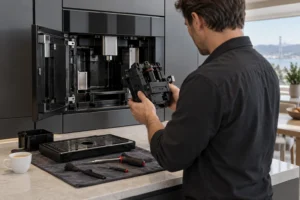
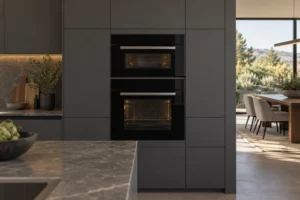
A wall oven lives in a cutout, usually a tall cabinet flanked by panels, sometimes stacked with a speed oven, a coffee machine or a warming drawer. That arrangement has consequences. Cooling air has to travel behind and around the oven, so a covered duct or a cabinet modified after installation can cause overheating messages. Removal for service means pulling the oven forward out of a tight housing, and the cabinet face, the countertop above and the supply behind all need to be understood first. In older San Francisco flats the circuit feeding the oven may also share a run with other loads, which affects how we think about tripping and intermittent power.
Built-in microwaves and speed ovens add their own details: the trim kit, the door seal and the way the unit vents into the cabinet. Under-counter and column placements differ again, and a 24-inch unit sits very differently from a 30-inch one. That is why we ask for the label and a photo of the installation when you book.
Do not remove the oven from the cabinet, do not open its panels and do not test the supply with a meter. Smoke, sparks or a burning smell on an empty oven mean power off at the breaker and no further use.
The label tells the technician whether the oven is a wall oven, a speed oven or a microwave and which parts apply. It is usually on the oven frame behind the door, so open the door and look along the edge. Our help page on finding the Miele model number shows other spots. Typical models include the H 2880 BP, the H 7270 BM speed oven and the M 7240 TC microwave. The Miele wall oven guide lists the wider lineup. If your oven also steams, see steam oven repair.
You send the label, the message and a short description. The technician checks the installation, tests the heating and the door lock where safe, and tells you what failed. You get a written estimate, and nothing is repaired without your approval.
Pyrolytic cleaning locks the door while the cavity is hot, and a lock that will not release is a recognized fault. Let the oven cool fully, check power and try the door again. If the lock still holds or a lock message appears, book a visit rather than forcing the door.
Not always. Food residue, packaging left inside or a first heat-up can smell. A smell that persists on an empty oven, comes with smoke or sparks, or follows a tripped breaker is different, so switch off at the breaker and arrange a diagnosis.
Yes. Speed ovens and built-in microwaves are part of the same family and share the cutout and installation questions of a wall oven, so one visit plan covers them.
It can be either. Rack position, oversized pans and cookware that blocks airflow cause uneven results, but a failed heating element, a fan that is not turning or a poorly reading sensor does the same. We check the oven empty and explain which it is.
The model label from the oven frame behind the door, the code or message on the display, whether the problem is heating, the door or the controls, and how the oven is installed, in a tall cabinet or under a counter.
Wall ovens, speed ovens and built-in microwaves in Bay Area kitchens: the lineup we see, common faults, display codes and safe first…
Water, brew unit, milk system or heating: we trace what stopped your Miele built-in or countertop coffee machine in San Francisco and…
Gas, electric and induction Miele cooktops and rangetops diagnosed in San Francisco and the Bay Area: igniters, zones, sensor controls, cooling fans…
Miele dishwasher diagnosis in San Francisco and the Bay Area: draining, water intake, pump, door and dispenser faults, with a written estimate…
Miele dryers that run damp, stop with a fault message or refuse to start get a diagnosis first. We serve San Francisco…
Share a few details and we’ll confirm an appointment. Prefer to talk? Call us and we’ll help right away.