


Specialized Miele Appliance Repair in San Francisco
Mon–Sat: 8:00 AM – 7:00 PM
When a Miele dryer needs extra rounds to finish a load, airflow, filters or a heating problem is usually behind it. Learn the checks to run and when a technician should step in.
Miele repairSan Francisco Bay Area
A dryer that used to finish in one cycle and now needs two is telling you that something has changed in the way air or heat moves through it. A drying cycle is a balance: warm air must pass through tumbling laundry, pick up moisture and leave the machine. Interrupt any step and the clothes stay damp, the cycle stretches, and the dryer works harder than it should.
Slow drying comes in a few distinct patterns, and noticing which one you have narrows the search.
Miele lists several messages that fit these patterns. Code F55 is described as laundry still damp after the maximum drying time. Code F66 usually points to fluff filters or the plinth filter not being cleaned or too wet, and also overload or blocked ventilation. Code F50 means the drum is too full. Code F158 means the appliance has overheated.
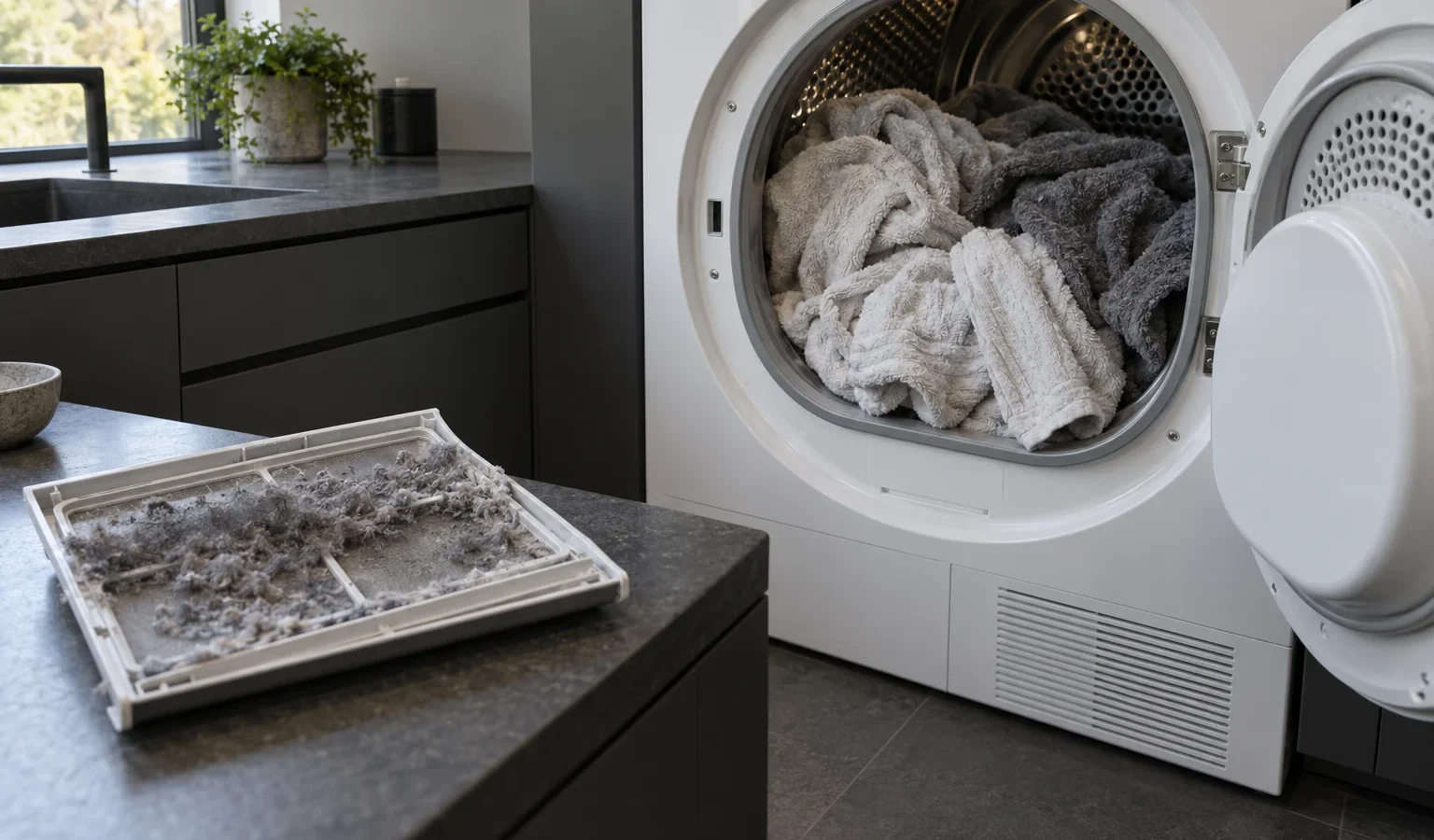
Lint is the first suspect in almost every slow dryer. Fluff filters trap lint, and even a thin film of it, or a filter that is wet from the previous load, slows airflow. On dryers with a plinth or base filter, that second filter needs the same attention. Dryers that remove moisture without a vent, including heat-pump designs, rely on a clear air path through filters and a condenser area, so a clogged filter shows up as a long cycle rather than a hot one.
The second suspect is the load itself. Too many items, or one heavy item such as a duvet, prevents tumbling and leaves wet pockets. Mixing thick towels with thin shirts means the thin ones are done while the towels are not, and the sensor keeps the cycle going.
Third comes ventilation around the machine. Many Bay Area homes tuck the dryer into a closet, behind bifold doors or in a stacked column above a washer. If the closet door is shut, the room cannot give or take air. Miele notes related ventilation problems under several of its fault messages, so a crowded closet is worth a look. Vented models also need their exhaust duct clear from the machine to the outside wall, and a long or crushed duct can add a lot of drying time.
Do these with the dryer switched off and cooled down.
Do not run the dryer with the filters out, and do not dry items that carry a flammable residue such as cooking oil, paint or solvent. Do not open panels to chase a heating problem. If the exhaust smells scorched or you see sparks, switch the dryer off at the breaker and leave it off. A Miele PDR 908 HP or any other model deserves the same caution: when something smells burnt, stop first and diagnose later.
If the filters are clean, the load is sensible, the room breathes and the dryer is still slow, the cause is likely internal. A technician looks at the temperature sensors, the blower and drive motor, the condenser or heat-exchange area, the door contact, the electronic module, and on heat-pump designs the compressor and the refrigerant temperature sensors. Miele describes F159 as a compressor start-up fault, F156 and F157 as faults at the refrigerant temperature sensor downstream of the condenser, and F3 and F4 as faults at the drying air temperature sensor. A failing sensor can cause a dryer to misjudge dampness and either quit early or run on.
A drive problem can also lengthen a cycle. Miele lists F53 for a defective drive motor or an electronic module fault, and F104 for low mains voltage at the drive motor.
Stacked columns, such as the washer and dryer pairs common in San Francisco flats and condos, need clear air at the front and a level base, since the dryer cannot open up like a freestanding unit. A technician must often slide the machine out to inspect the air path, so clear a path to the unit and tell us about narrow stairs, elevators or hallway turns when you book. Machines like the Miele TWB120 WP and Miele TXB 360 WP differ in how they are installed, so share the model number if you have it.
Use our guide on finding your Miele model number to locate the label, usually on the door rim or the frame behind the door. Tell us the display message, how long a cycle now takes, and what you cleaned. We diagnose before any repair, give a written estimate, and repair nothing without your approval.
For more detail read about Miele dryer repair, browse the Miele dryer lineup, or send a request through the contact page.
If a clean filter, a modest load and open airflow do not bring the drying time back to normal, the cause is probably mechanical or electronic rather than a habit problem.
Extra heat and tumbling wear fabrics over time and can shrink delicates. Fix the cause rather than running repeat cycles on the same load.
It can be. A closed closet limits the air the machine needs, so open the door during a cycle or ask whether a louvred door is an option.
Yes, a quick wipe or brush after each load is the simplest way to keep airflow strong. A wet filter should dry fully before it goes back in.
The model number, the display message if any, how the clothes feel at the end, and what you have already cleaned or tried.
Share a few details and we’ll confirm an appointment. Prefer to talk? Call us and we’ll help right away.