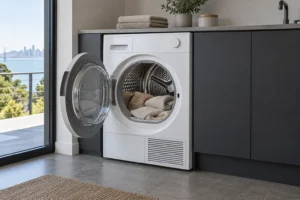
Dryers
A San Francisco guide to Miele dryers, including heat-pump units: models we list, label location, slow drying complaints, display codes and checks…

Specialized Miele Appliance Repair in San Francisco
Mon–Sat: 8:00 AM – 7:00 PM
Damp towels, a long cycle or a fault message on the display: we find the cause in your laundry setup before anything is replaced.
Miele repairSan Francisco Bay Area
A Miele dryer that stops short of dry, throws a fault message or trips out mid-cycle is usually telling you something specific, and the display text is the quickest way to find out what. We repair Miele dryers in San Francisco and around the Bay Area, from vented machines in garage laundry rooms to heat-pump models tucked into hallway closets, and every visit starts with a diagnosis before anyone discusses a repair.
Dryer complaints fall into a few groups, and sorting yours into one of them narrows the search before the technician arrives.
This is the most common call. Restricted airflow is the usual suspect: lint in the fluff filters, a clogged plinth filter in the base, a kinked vent hose behind a closet door, or a vent run that has collected lint over the years. On a condensing or heat-pump machine, the condenser and the refrigerant circuit have to exchange heat properly, so a dirty heat exchanger or a failing sensor shows up as slow drying too. Our article on why a Miele dryer takes too long walks through the order of checks.
A vented dryer relies on a heating element and thermal protection; a heat-pump dryer relies on a compressor and a sealed refrigerant loop. The temperature sensors in the drying air and in the refrigerant path tell the control board whether heating is working. When one of those sensors reads open or shorted, the dryer stops or limps through a cycle. Sealed refrigeration work is never an owner task, and it is never something to attempt with the panels off.
A dryer drum that does not rotate points at the drive motor, the belt arrangement or the electronics that command the motor. A squeal, a rumble or a thump that follows the drum is worth recording on your phone, because the sound and the moment it appears both help the diagnosis.
The dryer needs to know the door is closed before it runs. A worn door contact or a door that does not seat flat leaves the machine refusing to start, and the display may report a door signal problem.
Miele dryers show fault codes on the display, and several of them have clear meanings. Write the exact text down before you press anything.
The full list lives in our error codes page. Several entries, such as F38, F39 and F40, describe an electronic module fault, which is a diagnosis for a technician rather than something a reset repairs.
Where the dryer lives matters as much as what it does. Many San Francisco flats and row houses put laundry in a closet or a hallway alcove, often stacked, with a vent that has to travel a long way to an outside wall. A long or bent run, a crushed hose behind the machine and a closet door that stays shut during the cycle all choke airflow and mimic a failing dryer. In garages and basement laundry rooms, lint tends to accumulate around the vent termination and in the lower filter housing. Condensing and heat-pump machines have no vent but need room to breathe and a drain or container that is emptied; a stacked pair may also share a cabinet with limited access to the base.
Because of this, the first part of a visit is often a look at the surroundings: how the machine is connected, whether the hose is free, and whether the cabinet leaves a technician room to work. If your washer is in the same stack, our Miele washer repair page covers that side of the pair.
These are safe for any owner and often decide whether a visit is needed.
Do not remove back or base panels, do not probe the wiring, and do not try to move refrigerant components on a heat-pump unit. Our guide to heat-pump dryer filter care explains the routine cleaning that prevents many of these calls.
Switch the machine off at the breaker if you smell something burning, see sparks, or the housing is hot well after the cycle ended. Do not keep re-running a dryer that reports overheating, and do not run it with a vent that is disconnected. Lint is combustible, and a machine that keeps stopping on a temperature message deserves a pause, not another try.
Miele makes dryers in different constructions, and the label tells the technician which one is in your home and which parts apply. The label is usually on the door rim or the inside edge of the door opening. Our short guide on finding your Miele model number shows where to look. Models we see regularly include the PDR 908 HP, the TWB120 WP and the TXB 360 WP, and you can browse more in the Miele dryer guide.
You send the request with the model label, the message on the display and a short description of what the dryer does. The technician arrives, checks the installation and airflow, reads the fault history where the machine allows it, and confirms what failed. You then receive a written estimate. Nothing is repaired until you approve it. If the finding is a filter or a vent that you can clear yourself, we say so.
Damp loads usually point to airflow or a drying-air sensor rather than a dead machine. Clogged fluff filters, a dirty plinth filter, a crushed vent hose or a sensor reading wrongly can all stop the cycle from finishing. After the filter and vent checks, a technician measures what the dryer is actually doing.
No. When the display reports that the appliance has overheated, stop using it and leave the door closed until it has cooled. Clean the filters, check that nothing blocks the vent, and book a visit if the message returns.
Stacked and closet installations are common in Bay Area flats, and the visit plan accounts for them. Tell us how the pair is stacked and whether the dryer can be pulled out, so the technician arrives ready for the clearance you have.
One controlled power reset is a reasonable check, but write the message down first. If the same text comes back, the reset did nothing except confirm the fault is real, and the code is your strongest lead for the diagnosis.
The model label from the door rim, the exact message shown on the display, whether the machine is vented or condensing, and how long the problem has been present. Photos of the filters and the vent hose help as well.
A San Francisco guide to Miele dryers, including heat-pump units: models we list, label location, slow drying complaints, display codes and checks…
Water, brew unit, milk system or heating: we trace what stopped your Miele built-in or countertop coffee machine in San Francisco and…
Gas, electric and induction Miele cooktops and rangetops diagnosed in San Francisco and the Bay Area: igniters, zones, sensor controls, cooling fans…
Miele dishwasher diagnosis in San Francisco and the Bay Area: draining, water intake, pump, door and dispenser faults, with a written estimate…
Miele gas, dual fuel and induction ranges serviced in San Francisco and the Bay Area, from ovens that will not heat to…
Share a few details and we’ll confirm an appointment. Prefer to talk? Call us and we’ll help right away.