


Specialized Miele Appliance Repair in San Francisco
Mon–Sat: 8:00 AM – 7:00 PM
A worn or dirty door gasket lets warm air in and makes the compressor work harder. Learn how to clean, test and look after the seal, and when it needs a technician.
Miele repairSan Francisco Bay Area
The door seal on a Miele refrigerator is a flexible gasket that holds a cold barrier around the door. When it is clean and supple it presses evenly against the cabinet and keeps room air outside. When it hardens, tears, collects residue or sits out of shape, warm air leaks in all day, moisture condenses, frost builds, and the compressor runs far longer than it should. Seal care takes minutes and is one of the few refrigerator jobs that is entirely safe for an owner.
Cold air is heavy and sinks, warm humid air is drawn in wherever there is a gap. That moisture freezes on the coldest surfaces, so a leaking gasket often shows up as frost along one edge of the freezer or as damp beads on a door. In a San Francisco kitchen, where fog keeps indoor air humid for long stretches, the effect is easy to notice. The unit may still cool, but it does so while working harder, and the extra frost can eventually block airflow and lead to the problems described in Miele refrigerator not cooling.
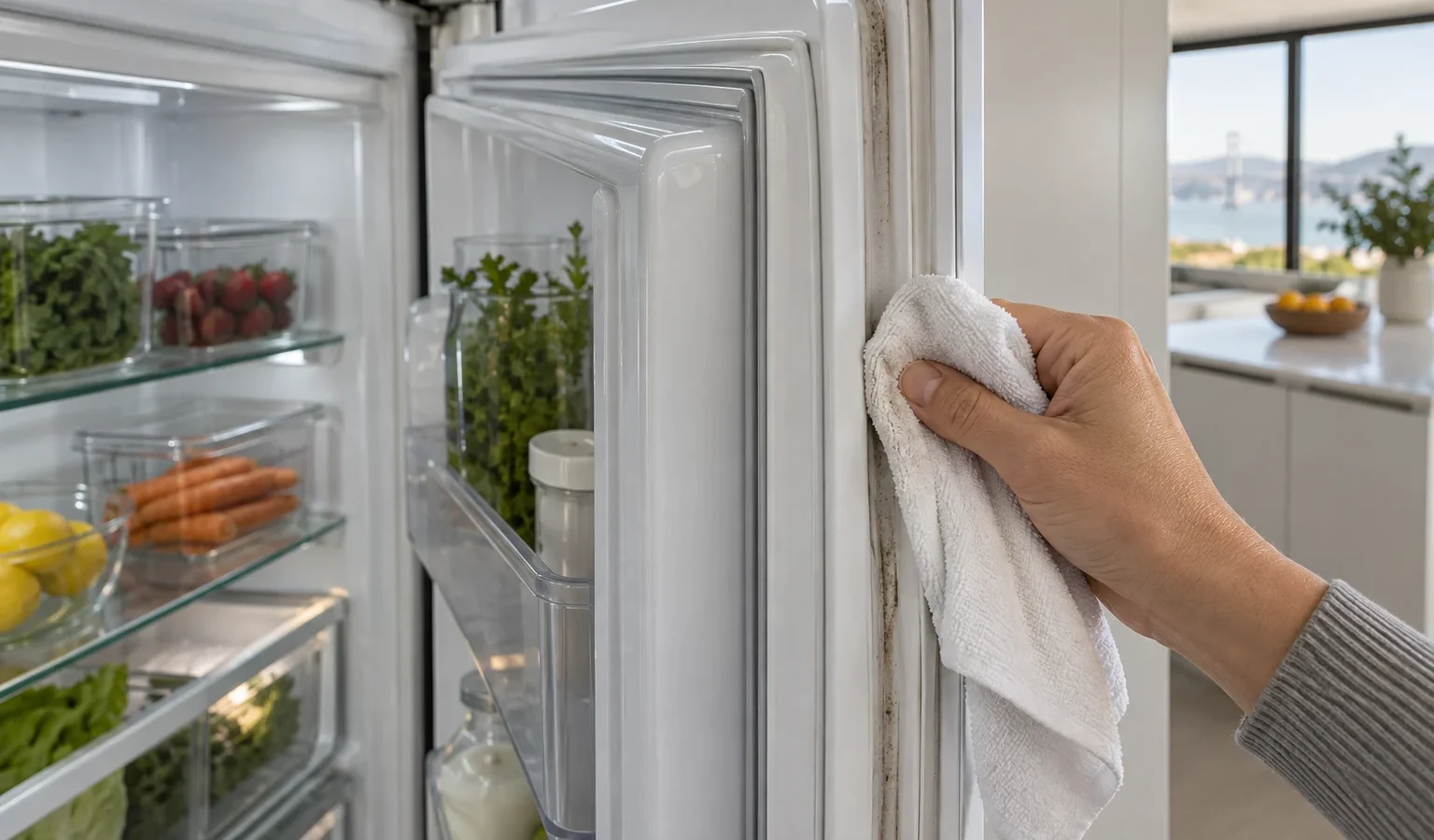
Use a soft cloth with mild dish soap and warm water. Wipe the visible face of the gasket and then gently pull back the folds and clean inside them, where spills and crumbs collect. Dry it thoroughly. Rinse off soap with a clean damp cloth, because a sticky film makes rubber cling to the frame and tear when the door is opened.
Avoid bleach, abrasive pads, solvents and sharp tools. Harsh cleaners dry out the rubber and sharp scrapers cut it. Do not pull on the gasket to remove it. Fitting a new one is a job for a technician on most built-in units.
Clean it regularly, particularly if the kitchen sees cooking grease. A rubber seal that stays clean stays flexible longer. Never coat it with oils, silicone sprays or petroleum jelly unless the Miele manual for your model calls for it, because products that suit one rubber can soften another. If the seal has stiffened or developed a ripple, a gentle warming of the sealing area with a damp warm cloth sometimes relaxes a mild kink.
A seal that looks fine can still leak when the door does not close squarely. Built-in and panel-ready units carry a decorative front that adds weight, and the hinge or door position can drift. Signs include a door that swings open on its own, a door that sits proud at one corner, or a seal that only meets the frame at the top. Those are installation and hinge issues for a technician, because adjusting a heavy panel against flush cabinetry takes care.
It is also worth checking that the unit is level, that the door is not catching on a neighboring cabinet handle and that contents do not stop it from closing. A basket or tray sticking out is a frequent cause of a door that rests slightly open.
If a door stays ajar, the display may warn you. The door-open alerts, such as Miele refrigerator F141 for the fridge compartment and Miele refrigerator F144 for the freezer, indicate that a compartment door has been open for a prolonged period. If one appears when you believe the door is shut, a poor seal, a catching hinge or an obstruction is the probable cause.
Make the gasket part of a routine tidy, for instance whenever you wipe the fronts of the cabinets. Look for small splits, check the corners and note whether the door still closes with a gentle push. Catching a slow change early makes the repair simpler.
Cleaning will not fix a gasket that is torn, permanently flattened, hardened or pulled out of its channel. If the paper test still fails after cleaning, if frost keeps forming on one side or if the gasket has visibly shrunk, ask for a diagnosis. The technician checks the seal, the hinges, the door alignment and the unit’s behavior, then tells you whether the gasket alone explains the problem. You receive a written estimate, and no part is replaced without your approval.
Your model number helps a technician confirm the right seal. It is usually on the label inside the cabinet, on a side wall or near the door frame. For a unit such as the Miele K 2812 Vi, a refrigerator in the MasterCool series, or the freezer Miele F 2611 Vi, give the full label text. Browse the Miele refrigerator lineup for context, or read Miele refrigerator repair for the visit process.
A wipe every few weeks is enough in most homes, and more often in a kitchen with a lot of cooking or small children. Wipe up spills near the door edge straight away.
Some gaskets clip or slide into a channel, but on built-in and panel-ready models the door is heavy and the fit is precise. A poorly seated gasket can leak worse than the old one, so ask for a technician.
It is a common sign, but defrost faults also cause frost. If the seal tests well after cleaning and frost persists, a diagnosis can separate the two.
A leaking seal forces the unit to run longer, which adds wear over time and raises energy use. It is better to fix the seal early than to wait for another part to fail.
Avoid direct heat. A warm damp cloth is gentler. If the gasket is distorted, it will probably need replacing.
Share a few details and we’ll confirm an appointment. Prefer to talk? Call us and we’ll help right away.