


Specialized Miele Appliance Repair in San Francisco
Mon–Sat: 8:00 AM – 7:00 PM
Warm shelves, a humming compressor or a freezer that frosts over all point to different faults. Here is how to read the symptoms and what an owner can safely check first.
Miele repairSan Francisco Bay Area
A Miele refrigerator that has stopped holding its temperature leaves you with a short window to act. The food is still cold for a while, the display may or may not be complaining, and you need to decide whether this is a ten-second fix or a service visit. The symptom is the most useful guide. A fridge that is warm everywhere behaves differently from one where the freezer is fine and the fresh-food side is not, and both differ from a unit that cools in bursts and then drifts warm.
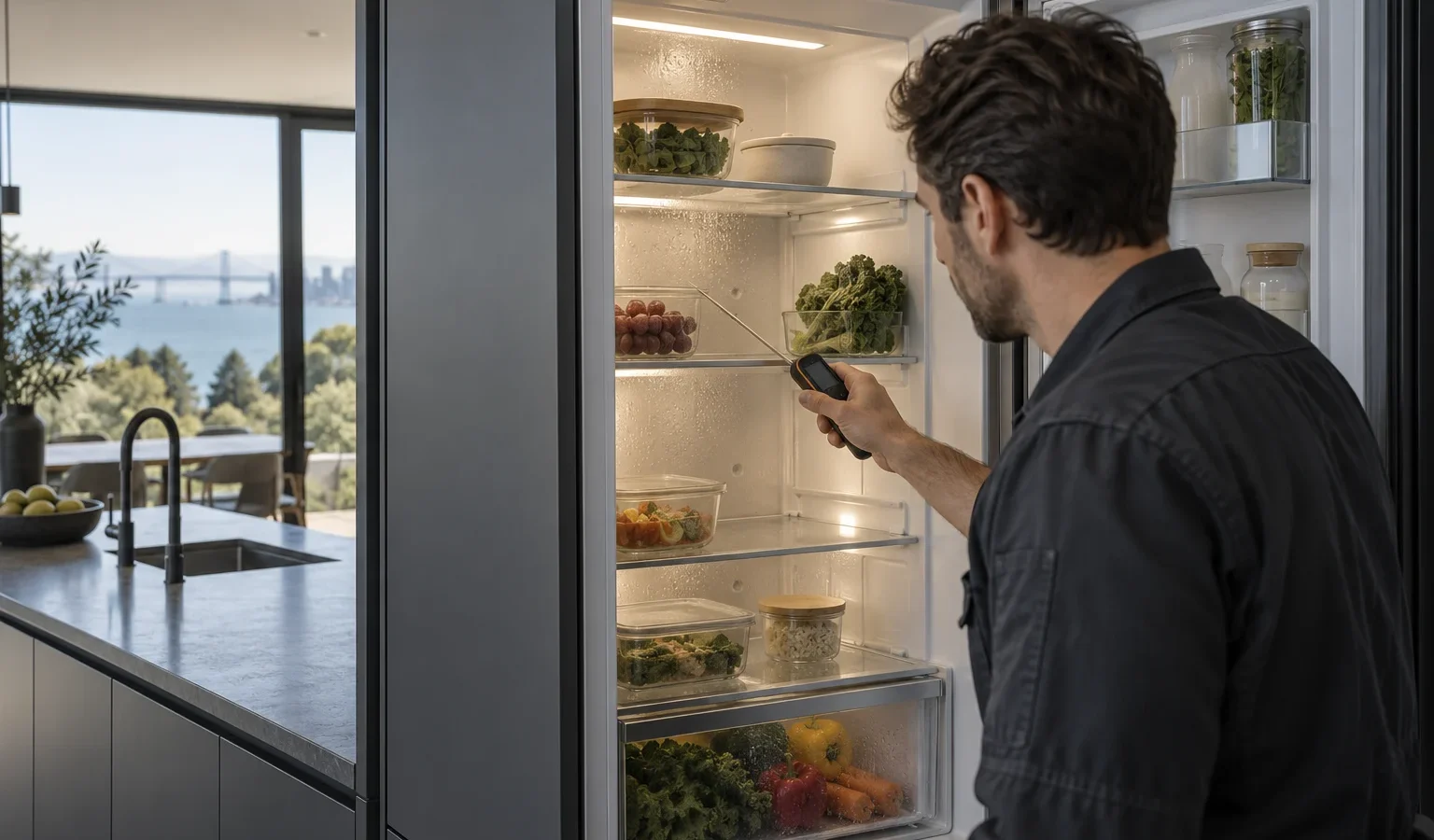
Open the door briefly and note where the warmth is. If both compartments are warm and you cannot hear any running at all, the unit may have lost power, been switched to standby or tripped a breaker. If you hear the compressor and fans running but the shelves are still warm, the sealed system may be running without moving cold air where it needs to go. If the freezer is cold while the fridge side is warm, airflow between the two compartments is the usual suspect, because many built-in models cool the fresh-food side with air that comes from the freezer evaporator.
Frost is another clue. A thick coat of ice on the freezer back wall, or ice around the vents, suggests the defrost system is not clearing the evaporator, so the coil is buried and no longer chills the air. That fault looks like a cooling problem but it lives in the defrost heater, the defrost sensor or the control that decides when to defrost.
That is where owner checks end. Do not remove interior panels, chip at ice with tools, or touch anything at the rear of the unit.
The evaporator fan pulls air across the cold coil and pushes it into the compartments. If it stops, slows or rubs against ice, the coil can stay cold while the shelves warm up. A fan that is struggling often announces itself first as a new ticking or whirring, which is why the Miele refrigerator making noise article is worth reading if the warmth came with a sound.
Frost builds up as a normal part of cooling, and a heater melts it away on a schedule. When the heater, its thermal protection or the sensor that tells the control to start defrosting fails, ice slowly closes the airway. A technician checks whether the coil is frosted, whether the heater is carrying current when it should, and whether the sensor reads sensibly.
If the compressor never starts, or starts and stops repeatedly, the cause may be a start component, a control signal that is missing or a mechanical fault. Sealed-system work is for a technician only, and a diagnosis tells you which of these you face.
A weak seal or a door that is not quite closing against flush cabinetry lets heat in all day. A unit boxed into a tight flat kitchen with little ventilation behind it can also struggle.
Some codes are purely informational. A door-open alert such as Miele refrigerator F141 only tells you a fridge door has been left open, and closing it properly clears the cause. Others point at the electronics or sensors, for example Miele refrigerator F114, which refers to the freezer section evaporator sensor. A low or unsteady supply voltage is covered by Miele refrigerator F120. Codes such as F0 to F5 are listed as technical faults that an owner cannot remedy, so a photo or a written note of the exact code is more useful than a reset attempt. Browse the full list under Miele error codes.
Keep the doors shut as much as possible. Move the most perishable items to a working cooler if the compartment stays warm. Discard anything that has been warm for a long time rather than judging by smell.
Book a visit when the unit stays warm after the outside checks, when frost keeps returning, when the compressor clicks on and off without settling, or when the display shows a technical fault. Switch it off at the breaker if you smell burning, see water pooling under it or hear sparking.
When you request a visit, have the model label ready. It is usually inside the fresh-food compartment on a side wall or near the door frame, and the fridge noise guide and our Miele refrigerator lineup page show where to look. For a column unit such as the Miele K 2802 Vi, a refrigerator in the MasterCool series, or a freezer like the Miele F 2601 Vi, the number lets the technician plan the visit around the right parts.
The technician diagnoses first, which means checking airflow, defrost behavior, the sealed system’s operation and any stored codes before suggesting a repair. You receive a written estimate, and nothing is repaired without your approval. Details for the whole category sit on the Miele refrigerator repair page.
On many units the fresh-food side is cooled by air that travels from the freezer coil. A blocked vent, a stalled fan or a frosted coil can leave the freezer cold and the fridge warm. Clearing items from the vents is the safe first step, and a persistent imbalance needs a technician.
One controlled power reset is reasonable, and a long switch-off can melt light frost. It does not repair a failed heater, sensor or fan, so if the warmth returns, book a diagnosis instead of repeating the routine.
No. Codes describe what the control noticed, such as a sensor reading, a door left open or an unstable supply. They narrow down the search but they do not name a failed part on their own.
Slightly warm for a short time may be fine, but dairy, meat and cooked leftovers are the first to suffer. Move the most perishable food to a working cooler and discard anything that has been warm for an extended period.
It is usually on a label inside the compartment, on a side wall or near the door frame. If the unit is panel-ready, open the door fully and look along the inner edges.
Share a few details and we’ll confirm an appointment. Prefer to talk? Call us and we’ll help right away.