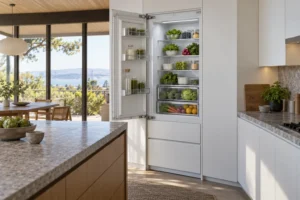
Refrigerators and Freezers
A guide to Miele built-in, under-counter and panel-ready refrigeration in San Francisco homes: the lineup, display codes, safe checks and when to…

Specialized Miele Appliance Repair in San Francisco
Mon–Sat: 8:00 AM – 7:00 PM
Built-in, panel-ready, column or undercounter, a Miele cooling appliance gets a diagnosis first and a written estimate before anyone repairs a thing.
Miele repairSan Francisco Bay Area
A Miele refrigerator or freezer usually disappears into cabinetry, which is the point of owning one. It also means that when something drifts, the first sign tends to be indirect: a carton that feels cool instead of cold, a puddle under the toe-kick, a ticking you never heard before, or a message on the display. We diagnose Miele refrigerators, freezers and refrigerator-freezers in San Francisco and around the Bay Area, and we explain what we find before any repair is approved.
The cabinet runs but the contents are not cold enough. Behind that one complaint sit several different faults. A refrigerator compartment that is cold at the top and warm at the bottom points to airflow. A freezer that frosts over in the back points to the defrost system, where a heater, a sensor or a control decision has stopped clearing ice from the evaporator. A cabinet that is simply warm all over may involve the cooling circuit itself, a fan, or a temperature sensor feeding wrong information to the electronics.
Models with an ice cube maker can fail in several places: the water line, the inlet valve, the mold, the electronics that run the cycle, or a household water pressure issue that has nothing to do with the refrigerator. Slow or absent ice, small cubes, or ice that tastes of the freezer are all worth describing precisely. See Miele ice maker not working.
Water under a built-in unit may come from a blocked defrost drain, a loose supply fitting, a cracked ice maker line, or condensation from a door that is not sealing.
Normal operation has its sounds, but grinding, rattling, loud buzzing or a fan that changes pitch deserves attention. Read Miele refrigerator making noise to match a sound to its likely source.
A hardened or torn gasket lets warm air in and forms frost near the door. See Miele refrigerator door seal care for what you can do yourself.
We start by listening to what you have seen and when it began, then look at the unit as installed. Level, clearance behind and above, door alignment, gasket contact and the condition of the water connection come first because they are quick to rule in or out. Next the technician checks which fans and heaters are active and whether the electronics report a fault.
You then receive a written estimate describing the fault and the proposed repair. Nothing is repaired until you approve it.
Miele refrigeration shows codes that begin with the letter F. Some are about how the unit is being used, and some are technical faults that belong to a technician. The meanings we publish are specific:
Codes such as F0 through F5 are listed as technical faults that you cannot clear yourself. Write down exactly what the display shows, including any code, and tell us when you saw it. For a wider overview, see Miele error codes explained.
Built-in cooling depends on air moving through gaps that the cabinet maker designed. When a remodel closes a vent, adds a tighter surround, or places a heat source such as an oven stack beside a column, the refrigerator can struggle without any part being faulty. Panel-ready doors add weight and rely on correct hinge setup; a front that sags can lift the gasket away from the cabinet and cause the very warm-air symptoms people blame on the cooling system.
Many San Francisco flats and condominiums leave little room behind the unit, and a pinched or old water line can mimic an ice maker fault. Undercounter models often sit close to a dishwasher or oven and pick up heat from them.
Before you call, a few outside-only checks sometimes solve the problem or at least sharpen the description:
Please do not remove interior panels, loosen cabinet trim to reach the rear, or touch the sealed refrigeration system. Do not chip ice from the evaporator.
Move food to another refrigerator if the cabinet stays warm. Switch off at the breaker if you notice a burning smell, sparks or a scorched odor, and keep the door closed to hold the cold. If water is spreading toward electrical outlets, shut off the supply and the power, and leave the repair to us.
Miele cooling appliances share a family look but differ inside, so the model label tells the technician which sensors, fans and ice maker arrangement to expect. It is usually on the door frame or the inside wall of the cabinet, and on a built-in unit it may need a door opened wide to read. Our post on how to find a Miele model number shows the usual places. Having it ready lets us bring the likely parts and shortens the visit.
Our lineup pages cover several cooling appliances, including the Miele K 2802 Vi repair page for a 30-inch refrigerator, the Miele F 2601 Vi repair page for a 24-inch freezer, and the Miele KF 2912 SF repair page for a 36-inch refrigerator-freezer. The Miele K 31222 Ui repair page covers an under-counter refrigerator. For the whole range, visit our Miele refrigerators guide, and for a symptom you have not found here, the Miele refrigerator not cooling article is a good start.
You request a time and tell us the model and the symptom. The technician looks at the appliance in place and gives you the diagnosis, a written estimate, and the choice to proceed or not.
Yes. The panel itself is not what we repair, but we work with it in place, and we check whether its weight or alignment is affecting the door seal.
Press the door shut, look for something wedged against the gasket, and read the display again. If the code returns with the door fully closed, the door sensing needs a technician.
Often it is airflow, and ice blocking the air path is a common reason. The technician checks the evaporator and fans to confirm before recommending a repair.
Not completely, but clear the front shelves and anything stored in the door so the technician can reach the interior and the label.
Check that the water supply valve is open and the line is not kinked, then tell us what the display says. Ice maker faults are diagnosed separately from the cooling system.
A guide to Miele built-in, under-counter and panel-ready refrigeration in San Francisco homes: the lineup, display codes, safe checks and when to…
Water, brew unit, milk system or heating: we trace what stopped your Miele built-in or countertop coffee machine in San Francisco and…
Gas, electric and induction Miele cooktops and rangetops diagnosed in San Francisco and the Bay Area: igniters, zones, sensor controls, cooling fans…
Miele dishwasher diagnosis in San Francisco and the Bay Area: draining, water intake, pump, door and dispenser faults, with a written estimate…
Miele dryers that run damp, stop with a fault message or refuse to start get a diagnosis first. We serve San Francisco…
Share a few details and we’ll confirm an appointment. Prefer to talk? Call us and we’ll help right away.