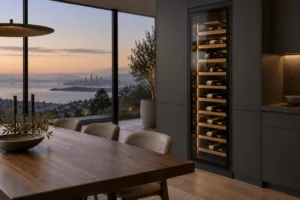
Wine Coolers
Under-counter and built-in Miele wine coolers in San Francisco homes: the models we list, where the label is, common faults and safe…

Specialized Miele Appliance Repair in San Francisco
Mon–Sat: 8:00 AM – 7:00 PM
Wine storage is judged by steadiness, so we look for the small drift that spoils it and explain the fix before you agree to anything.
Miele repairSan Francisco Bay Area
A wine cooler asks less of its cooling system than a kitchen refrigerator, yet it is less forgiving of drift. Bottles that sit slightly too warm age faster, and a unit that cycles hard or hums at night is annoying in an open-plan flat. We repair Miele wine coolers for owners in San Francisco and across the Bay Area, whether the cooler is built into a bar wall, tucked under a counter, or standing in a dining room niche.
The most common call is a cooler that no longer holds its set temperature. The cause may be as simple as a door that is not closing, or as involved as a fan that has stopped moving air, a sensor reporting the wrong reading, or a cooling circuit that is losing performance. In a wine cooler with more than one temperature zone, one zone can drift while the other is fine, which narrows the list of suspects considerably. Describe which shelf feels wrong and for how long.
Frost on the back wall or bottles that feel almost frozen suggest the control is not shutting the cooling off, or that humid air is entering through a poor seal and freezing on the coldest surface. A technician separates a control fault from a seal problem by looking at how the unit behaves between cycles.
Fans can whine when a bearing wears or a blade touches built-up debris. A rattle may be a bottle rack, a loose trim strip or the cabinet side touching the unit. Low humming from the compressor area is part of normal life, but a sound that changes or grows louder is worth a visit.
A hardened gasket lets warm room air in. A dim or flickering interior light and a display that goes blank are separate from cooling, yet they often show up together when the electronics are failing. We check each so you know whether one fault or several are involved.
We begin with the installation: is the unit level, is it getting the air it needs, and does the door close squarely onto its seal? Then we look at the temperature behavior across the zones, listen to the fans and compressor as they start and stop, and read anything the display shows. The result is a clear statement of the fault and a written estimate. We repair nothing without your approval.
The articles Miele wine cooler not cooling and how to find a Miele model number help you prepare before a visit.
We do not have fault-code pages for wine coolers, so we do not give meanings for numbers you may see. If a code or message appears, photograph it or write it down word for word, and note whether the cooler was opened, moved or unplugged just before. That detail helps the technician more than a guess at the meaning would. For codes on other appliances in your kitchen, see the error codes page.
Built-in wine coolers rely on the clearances the cabinet maker allowed. When a remodel boxes the unit in, places it next to a dishwasher or an oven, or covers a ventilation grille with trim, heat has nowhere to go and the cooler struggles. Undercounter installations in San Francisco flats are often tight, and the unit may sit on a floor that is not quite level, which can strain the door seal and change how it closes.
Panel-ready or framed fronts add weight to the door. A front that hangs a little low can leave a thin gap at the bottom that is hard to see but easy to feel with a hand. Where the cooler sits in a bright room or beside a window, direct sun can warm the cabinet side and make the unit work harder than it should. We note these conditions in our diagnosis because they change whether a part is the answer.
Please do not open panels, pull the unit from its cabinet by force, or attempt anything on the sealed cooling circuit.
If the cooler smells of burning, makes sparks or trips a breaker, switch it off at the breaker. If bottles you value are warming, move them to a cooler place while the unit is being looked at. Water running out of the cabinet should also stop you from using it until it is checked.
Wine coolers within the same brand differ in zones, shelving and controls, so the model label tells us what to expect inside. It is usually on the inside wall or near the door frame. With the model in hand, we can plan the visit around the likely parts.
Pages for individual coolers include the Miele KWT 2672 ViS repair page and the Miele KWT 6722 iS repair page, both listed at 24 inches. We also cover the Miele KWT 6312 UGS repair and Miele KWT 6322 UG repair models. For an overview of the range, read our Miele wine coolers guide.
You book a time and tell us the model and the symptom. The technician looks at the cooler where it stands, measures how it behaves, and explains the fault in plain terms. You get a written estimate, and you decide whether to go ahead. If a part must be ordered, we agree the follow-up visit with you before leaving.
A door that is not sealing, a blocked vent, a hot location or a sensor reporting incorrectly can all keep it running. The technician checks installation and seal first, then the controls.
Often yes, since much of the work is done from the front. If the unit has to be pulled out, we check that the cabinetry allows it before we begin.
A thin film is not unusual, but a growing layer or ice on the bottles is a sign that the control or the seal needs attention.
We recommend moving valuable bottles to a stable spot during repair, because the cooler may be off while parts are replaced.
Yes. Tell us which zone is misbehaving, because that detail points to the cause quickly.
Under-counter and built-in Miele wine coolers in San Francisco homes: the models we list, where the label is, common faults and safe…
Water, brew unit, milk system or heating: we trace what stopped your Miele built-in or countertop coffee machine in San Francisco and…
Gas, electric and induction Miele cooktops and rangetops diagnosed in San Francisco and the Bay Area: igniters, zones, sensor controls, cooling fans…
Miele dishwasher diagnosis in San Francisco and the Bay Area: draining, water intake, pump, door and dispenser faults, with a written estimate…
Miele dryers that run damp, stop with a fault message or refuse to start get a diagnosis first. We serve San Francisco…
Share a few details and we’ll confirm an appointment. Prefer to talk? Call us and we’ll help right away.