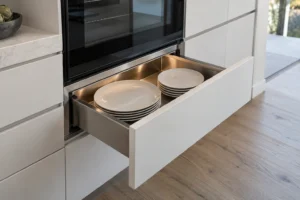
Warming and Vacuum Sealing Drawers
Miele warming drawers and a vacuum sealing drawer: sizes we service, common faults, where the label is and checks you can do…

Specialized Miele Appliance Repair in San Francisco
Mon–Sat: 8:00 AM – 7:00 PM
Built into cabinetry and easy to overlook, a drawer that stops heating or gliding is diagnosed carefully before any repair.
Miele repairSan Francisco Bay Area
A warming drawer sits quietly under an oven or in a run of cabinets and is easy to forget until the dinner plates come out cold. We repair Miele warming drawers and vacuum sealing drawers in San Francisco and the Bay Area, in both kitchens with panel-ready fronts and plainer layouts.
The drawer powers up, the display looks right, and the plates are still cool after a long wait. A heating element that has failed, a temperature sensor that reports wrongly or a control that never calls for heat are the usual candidates. Wiring that was disturbed during a remodel is another. Our post on a Miele warming drawer that is not heating goes through the checks in order.
These drawers carry weight and move on rails and a drive. A drawer that sticks, opens only partway, closes with a thud or does not respond to a touch on the front may have debris in the track, a worn roller or a mechanism that needs adjustment. If it jams while loaded, remove the load carefully before trying again.
A vacuum sealing drawer works differently. It draws air from a bag or container, and a leak in the seal, a pump that runs without building suction, a dirty drawer edge or a lid that does not seat will each stop a good seal. Wiping the sealing surfaces and checking the bag are safe starting points, but a pump fault needs a technician.
A new drawer may smell slightly during its first heating. A persistent burning odor, a clicking that does not stop or a display that goes blank is something else. Food spills that drip onto a heating element are an easy way to produce smoke, so keep the interior clean.
Drawers vanish into cabinetry, and that shapes the work.
We start with the symptom you describe and watch the drawer run through its normal use. For heat we look at how the unit responds to a setting and whether it reaches a warm state; for movement we study the glide and the front; for vacuum sealing we watch the pump and the seal. We tell you what we found before anything is repaired. Many drawer faults trace to one failed part, and finding it before we order anything keeps the estimate honest. If the drawer is part of a run of built-ins under an oven, we look at how the neighboring cabinet doors and panels sit, because a slightly shifted panel can rub the drawer front and mimic a mechanical fault.
Do not remove the drawer from its rails, open any panel or handle the wiring behind it.
If the drawer smells of burning plastic, smokes, sparks, gets hot on the outside, or the front becomes warm enough to hurt cabinetry, power it off at the breaker. Do not keep warming food in a drawer that is not behaving, because uneven heat can leave food in a poor state.
The label is usually found on the drawer front edge or behind the drawer front when it is opened, and sometimes inside the cavity. The model number separates a warming drawer from a vacuum sealing drawer and tells us the right parts. If you cannot find it, our note on finding a Miele model number helps, and a photo is enough.
You request a visit with the model if you have it and a short description. We diagnose first, tell you the result, provide a written estimate and repair nothing without your approval. Hours are Monday to Saturday, 8:00 AM to 7:00 PM. Please mention parking, stairs and any restrictions in the building, especially in a condo where work hours are limited.
The Miele warming and vacuum sealing drawer guide describes the lineup and the complaints we see most.
A failed element, a sensor that reads wrongly or a control that never asks for heat are the usual causes. Confirm the breaker and display, try a different setting, and book a diagnosis if the drawer stays cold.
No. Forcing it can bend the rails or damage the drive. Take the load out gently, check the track for debris and let a technician look at it if it still binds.
Wipe the sealing surface and the bag area and check the bag for creases. If the pump runs but suction never builds, a worn seal or a pump fault is likely and needs a technician.
It can. The panel adds weight and affects how the drawer glides, so we check balance and alignment as part of the diagnosis.
Usually on the drawer front edge or behind the drawer front when it is open, and sometimes inside the cavity. A clear photo is enough for us.
Miele warming drawers and a vacuum sealing drawer: sizes we service, common faults, where the label is and checks you can do…
Water, brew unit, milk system or heating: we trace what stopped your Miele built-in or countertop coffee machine in San Francisco and…
Gas, electric and induction Miele cooktops and rangetops diagnosed in San Francisco and the Bay Area: igniters, zones, sensor controls, cooling fans…
Miele dishwasher diagnosis in San Francisco and the Bay Area: draining, water intake, pump, door and dispenser faults, with a written estimate…
Miele dryers that run damp, stop with a fault message or refuse to start get a diagnosis first. We serve San Francisco…
Share a few details and we’ll confirm an appointment. Prefer to talk? Call us and we’ll help right away.